
CDP / Contact Fields
Contact Fields allow you to store, calculate, and utilize customer information to personalize your Customer Journeys and power target campaigns. With our Customer Data Platform (CDP) capabilities, you can leverage standard user attributes, real-time increments, or historical behavioral aggregations.
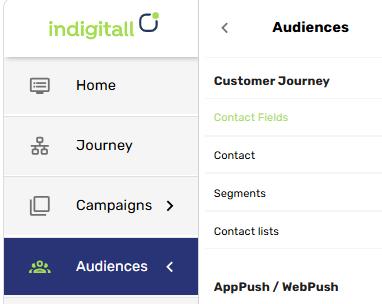
To get started, navigate to Audiences/Customer Journey > Contact Fields.
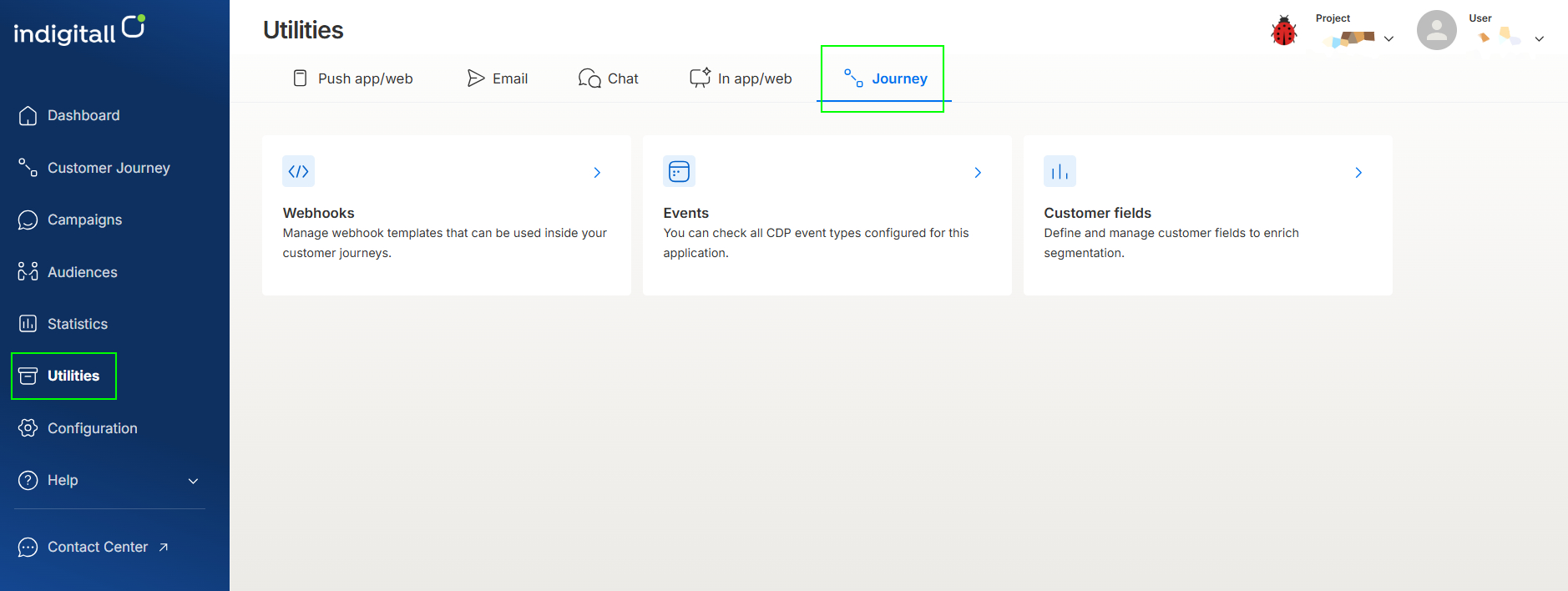
Journey tools now in Utilities
Starting October 14, Webhooks, Events, and Customer fields are in the new menu’s Utilities section. Click Utilities in the main left-hand menu, then select the Journey tab, the last tab on the right.
On the Journey tab, you’ll find three cards. Click a card to open it:
- Webhooks: Manage the webhook templates you can use in your customer journeys.
- Events: See all the CDP event types configured for your application.
- Customer fields: Define and manage customer fields to enrich your segmentation.
Add fields
To add a new field, simply click on the + Add Field button located on the right side of the screen. Please ensure the field name you create matches the exact nomenclature used in your CRM or database; both fields must be identical to ensure proper data synchronization.
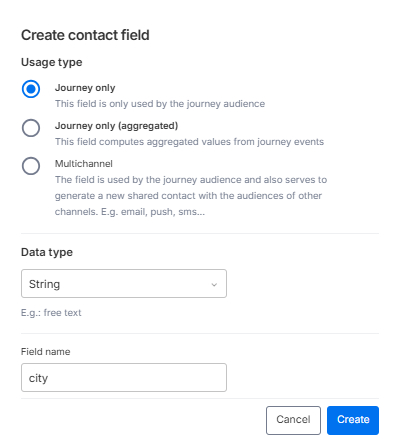
When creating a new contact field, you can select from four core data types: Number (for numerical data), String (for words or alphanumeric characters), Date (for specific calendar days), or Date and time (for precise timestamps).
Usage Types
When you create a contact field, you must choose one of three configuration models based on your data source and targeting goals.
Journey Only
- Purpose: Best for standard user attributes relative to the audience profile (e.g., favorite category, preferred language, VIP tier status).
- Characteristics: These fields are fully editable and are strictly utilized within the context of Customer Journeys.
- Configuration: Requires only a Data type selection and a custom Field name.
Journey Only (Aggregated)
- Purpose: Used for calculated tracking metrics that depend on mathematical operators and behavioral historical events (e.g., total spent over the last month, maximum consecutive gym visits, total completed checkouts).
- Characteristics: These fields are not directly editable by users because their values are computed dynamically by system background processes.
- Configuration: Requires a Data type, Field name, and an Aggregation configuration.
The system provides specific Aggregation Functions depending on the selected Data Type:
- Number: Average, Sum, Count, Minimum, Maximum, Last, First
- String: Last, First
- Date: Last, First
- Date and Time: Last, First
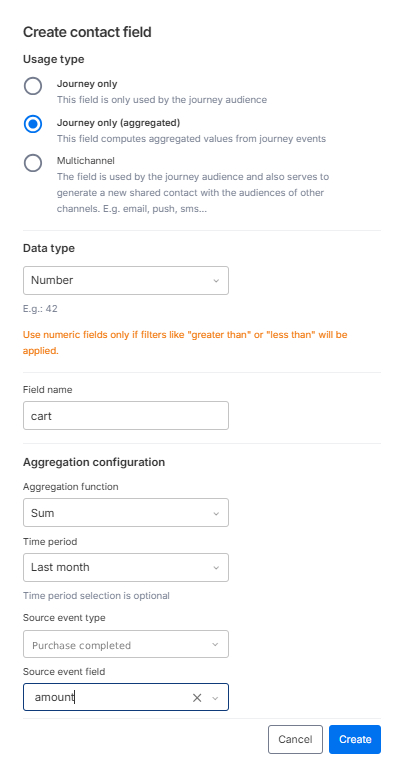
To finalize an aggregated field, you must also define:
- Time Period (Optional Window): The lookback time window for the calculation.
- Source Event Type: The specific tracking action (e.g., Purchase completed).
- Source Event Field: The payload property to calculate (e.g., amount).
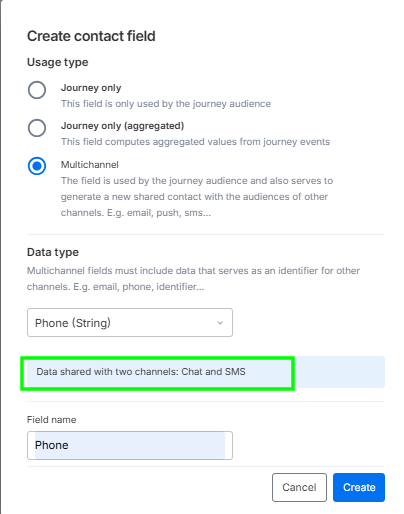
Multichannel
- Purpose: Explicitly reserved for unique core contact identifiers that you will need if you execute single-channel standalone marketing actions outside of a comprehensive Customer Journey.
- Characteristics: Creating these fields here ensures data consistency across the ecosystem, validation, and proper identity mapping. These fields operate seamlessly within both advanced Customer Journeys and standalone blast campaigns.
- Configuration: Requires selecting a multichannel identifier category and providing a Field name.
- Channel Mapping Constraints:
- Phone & Country Code fields serve the Chat and SMS channels.
- Email fields serve the standalone Email channel.
Managing and Actions
You can view, search, and manage your full list of attributes directly from the Contact fields dashboard.
The main dashboard table displays key overview columns:
- Name: The designated system attribute string identifier (accompanied by an "Aggregated field" tag if applicable).
- Creation date: Timestamp marking when the field was initiated.
- Data type: The structural classification (Number, Date, String, etc.).
- Usage type: The chosen functional model (Journey only, Multichannel, etc.).
Modifying Attributes

To edit or remove a field, look to the right-hand column of the table row. Click the three-dot icon to expand the actions menu.
- Select Edit to modify allowed configuration keys.
- Select Delete to permanently purge the contact attribute tracking configuration from your schema.
Aggregation Behavior Glossary
- avg: Computes the arithmetic mean of a selected numeric property across valid event payloads. Use case: Calculate average purchase value over the last 30 days.
- sum: Adds up all numerical entries from matching logs. Use case: Total spend tracked inside a specific seasonal threshold.
- count: Tracks the absolute quantity of target actions occurring within the set window frame. Use case: Total log counts of app opens over a rolling weekly period.
- min / max: Pulls the lowest or highest registered record (numeric values or date timelines). Use case: Identifying the earliest interaction date or identifying the highest value shopping cart item.
- last / first: Captures the absolute terminal or foundational value logged in chronological order. Use case: Pulling the exact status payload of an abandoned cart segment.
Updated 16 days ago