
Project Requirements
To work with indigitall console you need several basic requirements depending on the channels. Please, you can contact us to ask any doubt. First it is necessary to create each project with all requested requirements for the channels you will use: app push, web push, email, SMS, wallet and chat.
General
To see your projects, access the indigitall console and click on the side menu Configuration.
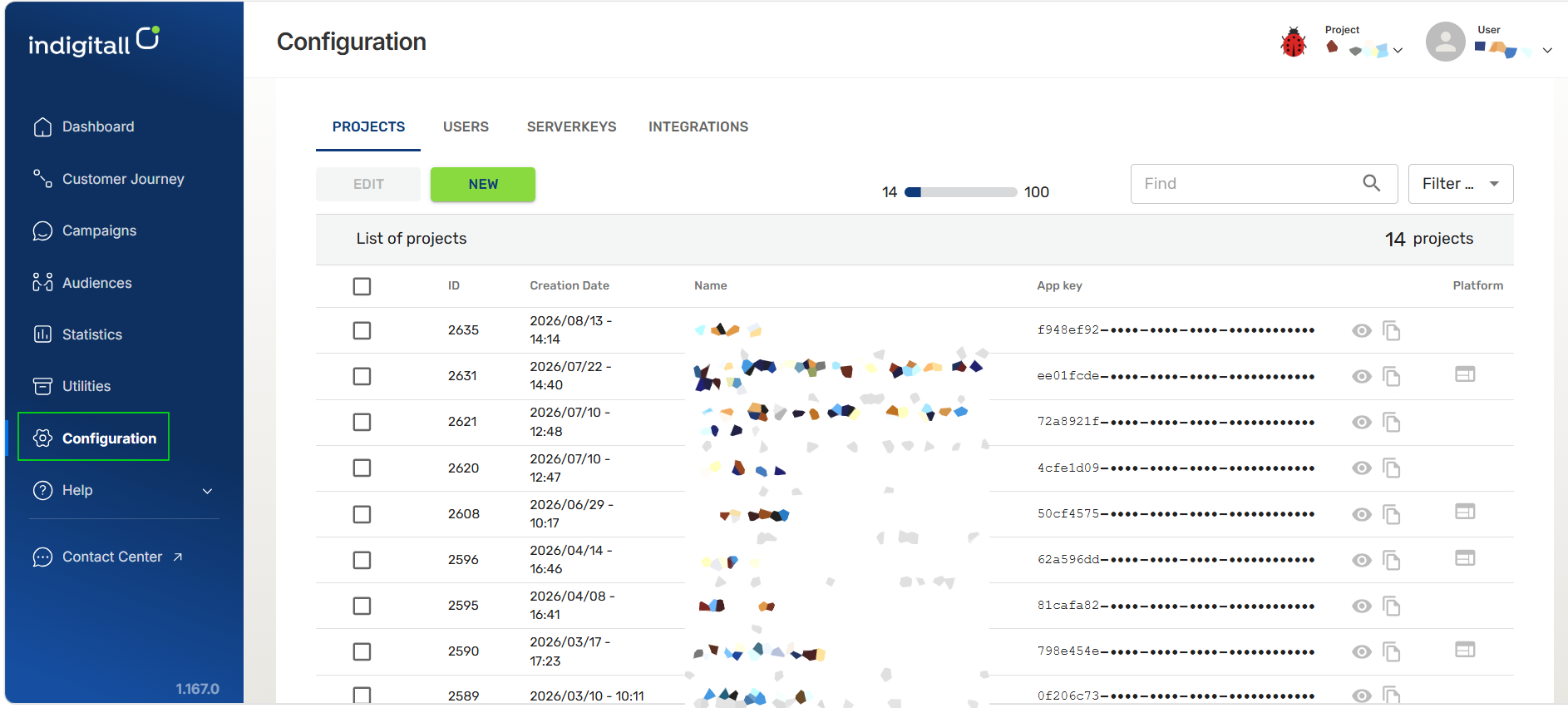
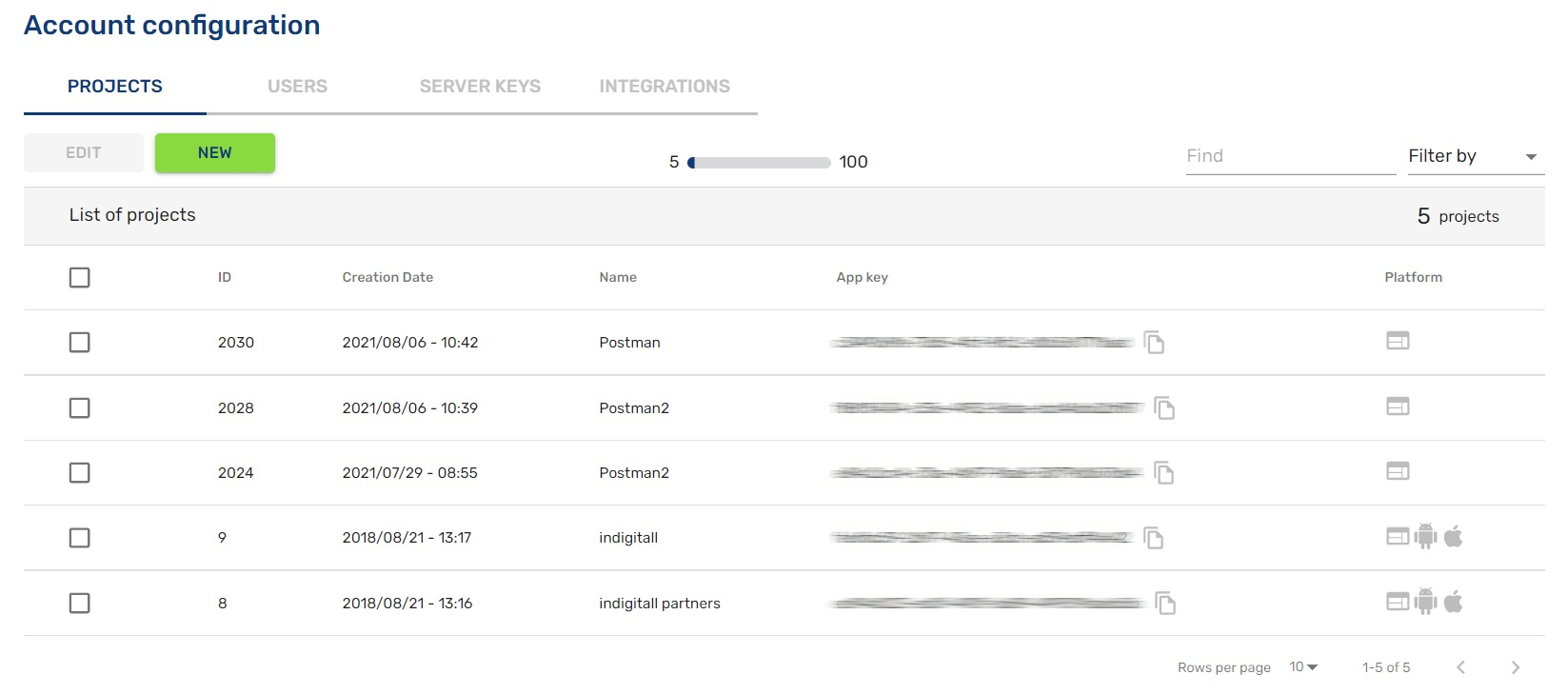
In the list of projects, the ones you have created will appear, under these parameters:
ID - unique code to identify the project.
Creation date - date the project was created.
Name - name that you have assigned to the project.
App Key - unique and personal value that will link your web / app with the project.
Platform - if it is an app, web or hybrid project (app and web).
To create a new project, access your indigitall console and click on Projects > New .
You will see a screen like this:
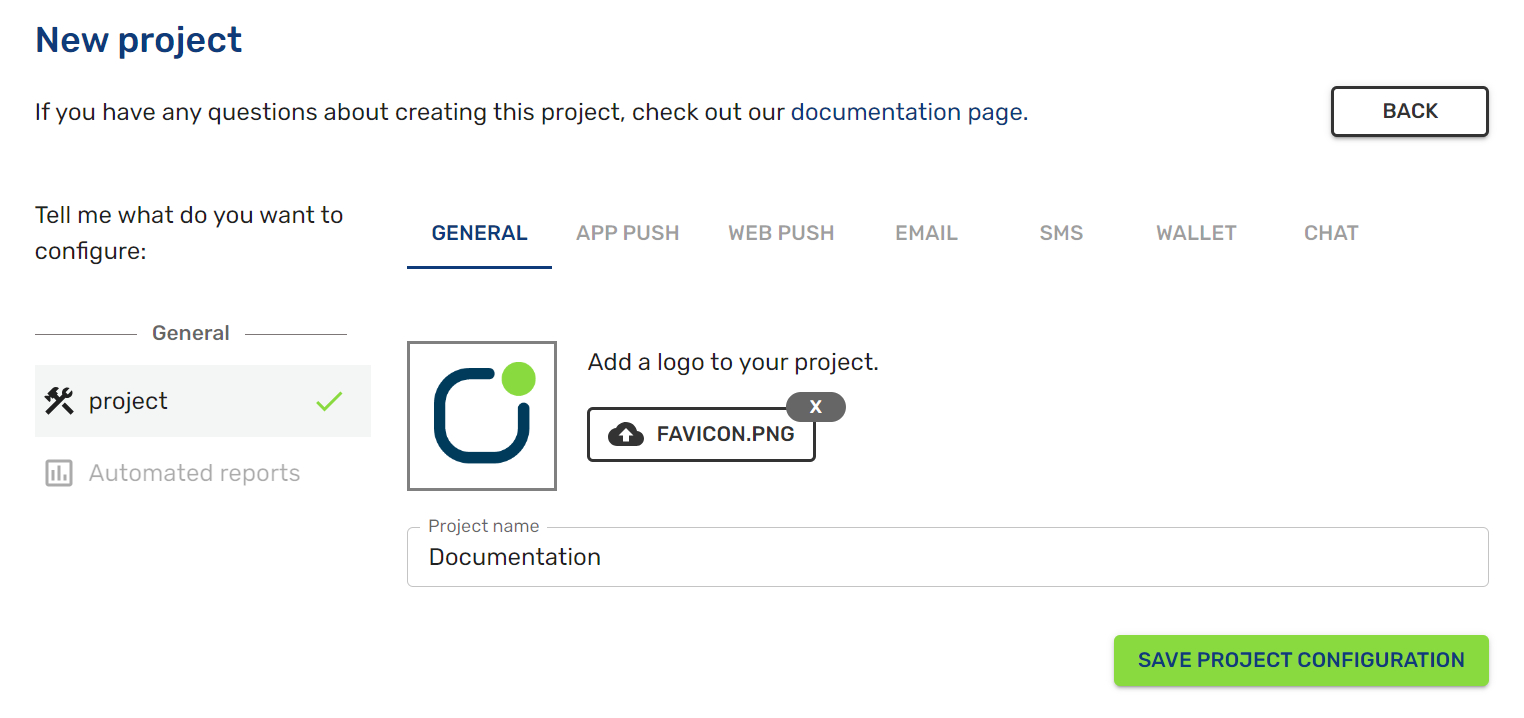
The fields to complete are:
Image: if you upload an image, it will be set as an icon to differentiate your project from others.
Project name: name for the project.
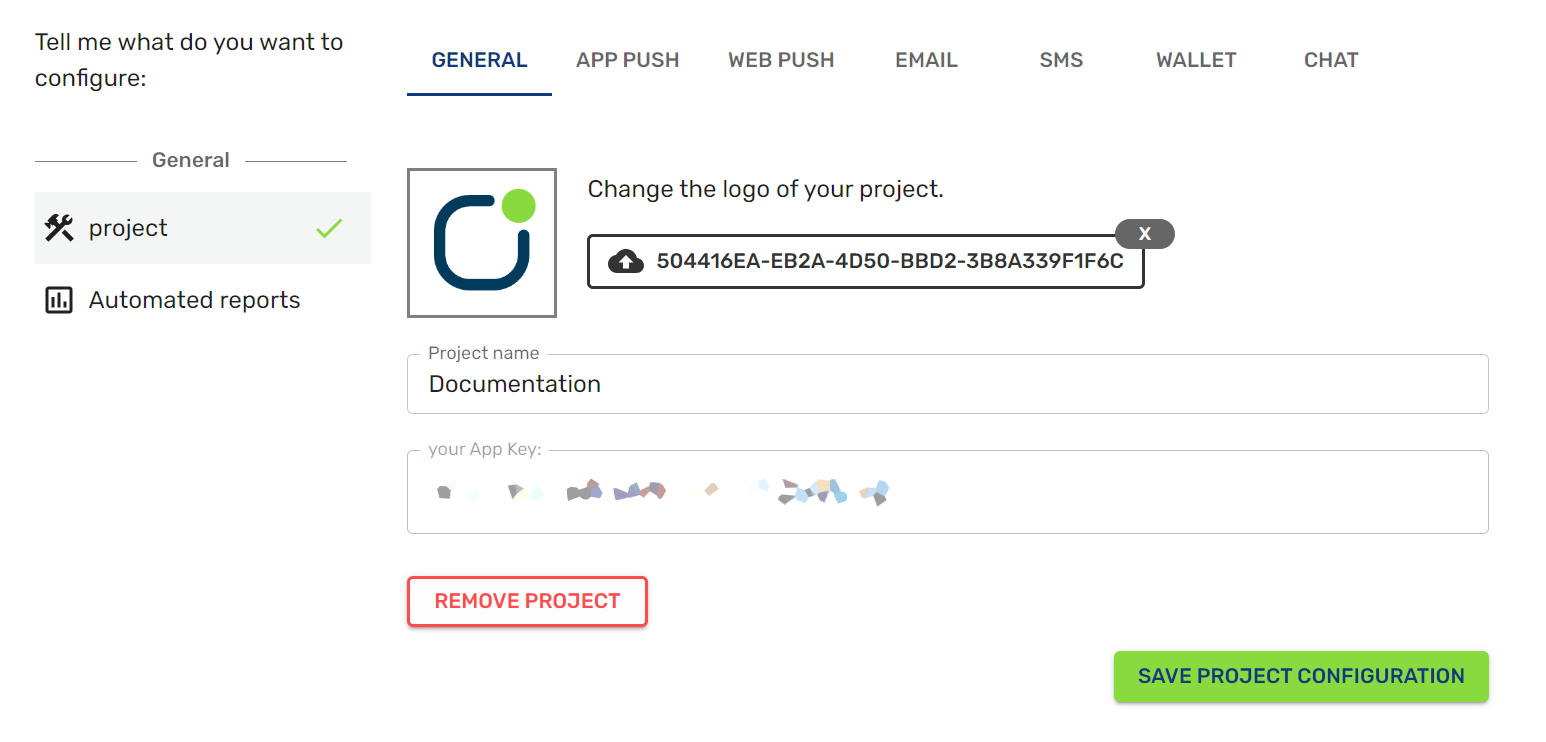
After clicking on the Save Project Configuration button, another screen appears with the App Key generated automatically.
Automated Reports
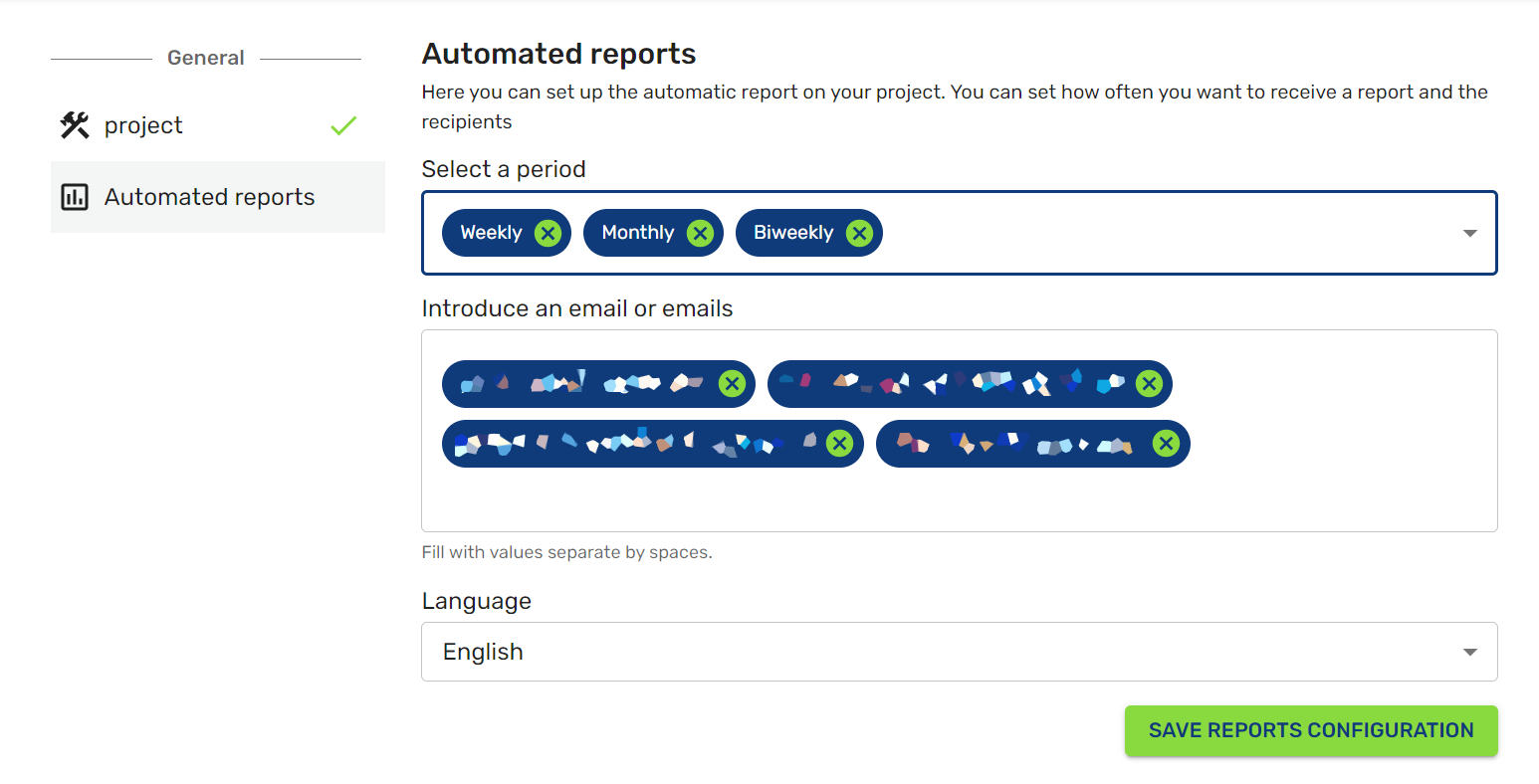
Choose how often you want to receive an automatic report of your project, who you want to receive it and in which language.
Next, we will explain how you can configure each type of project.
Web Push
Browsers
Once you have chosen the type of web project, you will see the Allowed Domains field.
This field will indicate which domains have access to your project.
If you leave the field blank, all domains will be accepted as valid, and will be saved with the asterisk * symbol, as you can see in the following image.
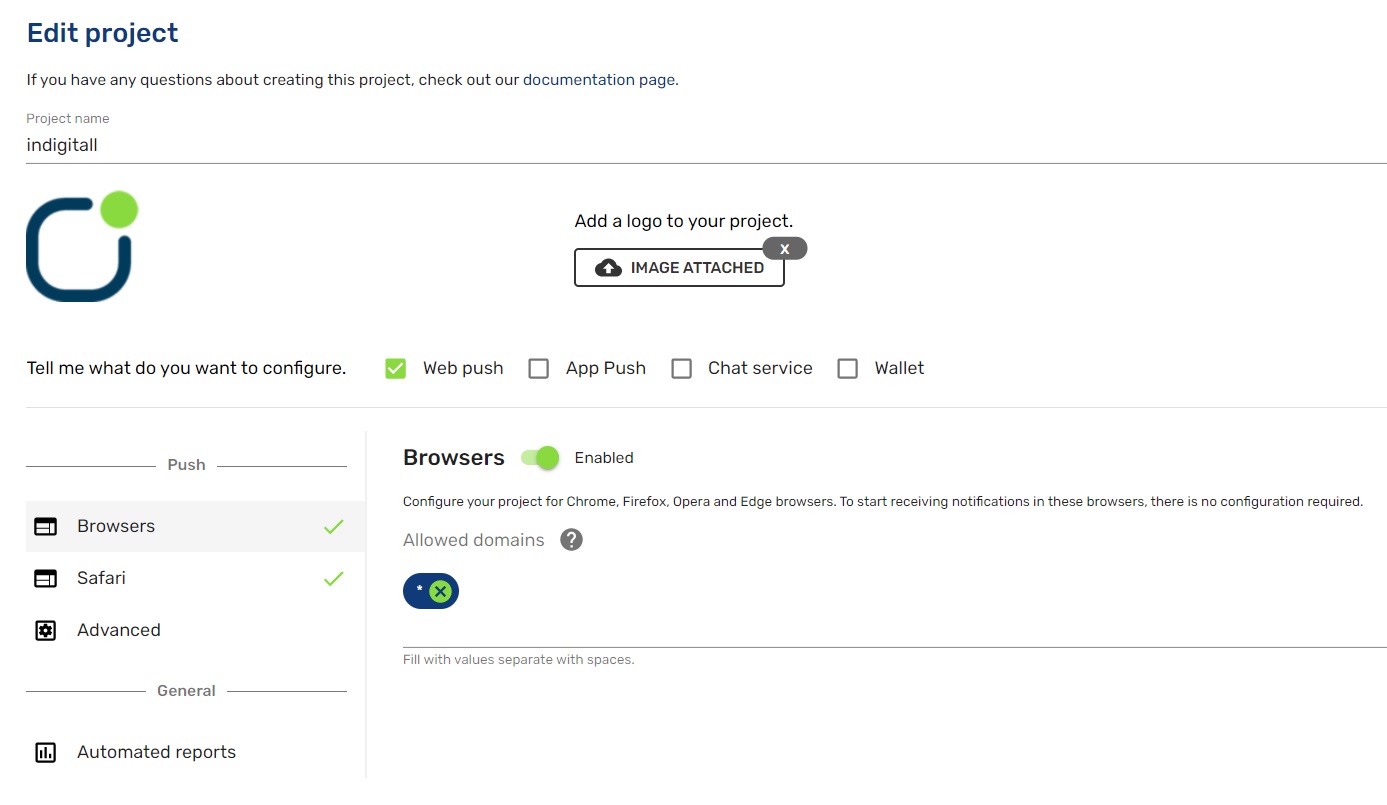
Project name - name that is assigned for your website or app.
Image - if you upload an image, it will be set as an icon to differentiate your project from others.
Project type - if you want to create a project for a website, for an app or for both.
Safari
To configure your project in Safari browsers, it is necessary to implement a subscription button to request the permission to receive notifications.
It is important to ensure that users can easily find this button and they can subscribe to your web push notifications. The user has to click on this button before receiving the permission notification for web pushes.
Here's an example code:
<script>
  var indigitallParams = {
    appKey: "xxxxxxxx-xxxx-xxxx-xxxx-xxxxxxxxxxxx",
    workerPath: '/indigitall/worker.min.js'
  };

  function onIndigitallLoaded(){
    indigitall.init(indigitallParams);
    if(indigitall.isSafariPushNotificationSupported() && !localStorage.getItem('indigitall.repository.PUSH_TOKEN')){
        var button = document.createElement("span");
        button.innerHTML = `<div id="indigitall-button" onclick="indigitall.launchNotificationPermissionForSafari();document.getElementById('indigitall-button').remove();" style="position: fixed; bottom: 15px; left: 15px; z-index: 999; transition: .2s ease;">
        <a style="display: block; border-radius: 50%; border: 1px solid #74d227; width: 50px; height: 50px; color: #fff; background: linear-gradient(to bottom,#89da3e 1%,#6dbf37 100%); text-align: center; vertical-align: middle; line-height: 60px; cursor: pointer; box-shadow: 0 0 3px #000; transition: .35s ease; transition-property: all; font-size: 20px; text-shadow: 0 0 2px rgba(0,0,0,.5); position: relative;">
            <svg style="width:24px;height:24px" viewBox="0 0 24 24">
            <path fill="#f5f5f5" d="M21,19V20H3V19L5,17V11C5,7.9 7.03,5.17 10,4.29C10,4.19 10,4.1 10,4A2,2 0 0,1 12,2A2,2 0 0,1 14,4C14,4.1 14,4.19 14,4.29C16.97,5.17 19,7.9 19,11V17L21,19M14,21A2,2 0 0,1 12,23A2,2 0 0,1 10,21" />
            </svg>
        </a>
        </div>`;
        document.getElementsByTagName("body")[0].appendChild(button);
    }
}
</script>

<script src="/indigitall/sdk.min.js" onload="onIndigitallLoaded()"></script>
Advanced
In advanced, you can use various parameters to improve the effectiveness of your notifications.
- Chunked delivery: If chunked delivery is enabled, you can set a rate of notifications per hour that will be delivered every time you send a campaign instead of delivering them immediately.
- Notifications per hour - You can set the number of notifications sent per hour. The minimum number of notifications per hour is 12,000. (Setting 12,000 notifications per hour is equivalent to sending 1,000 notifications every 5 minutes every hour).
- Add exclusion time - choose the time slot in which you do not want notifications to be sent.
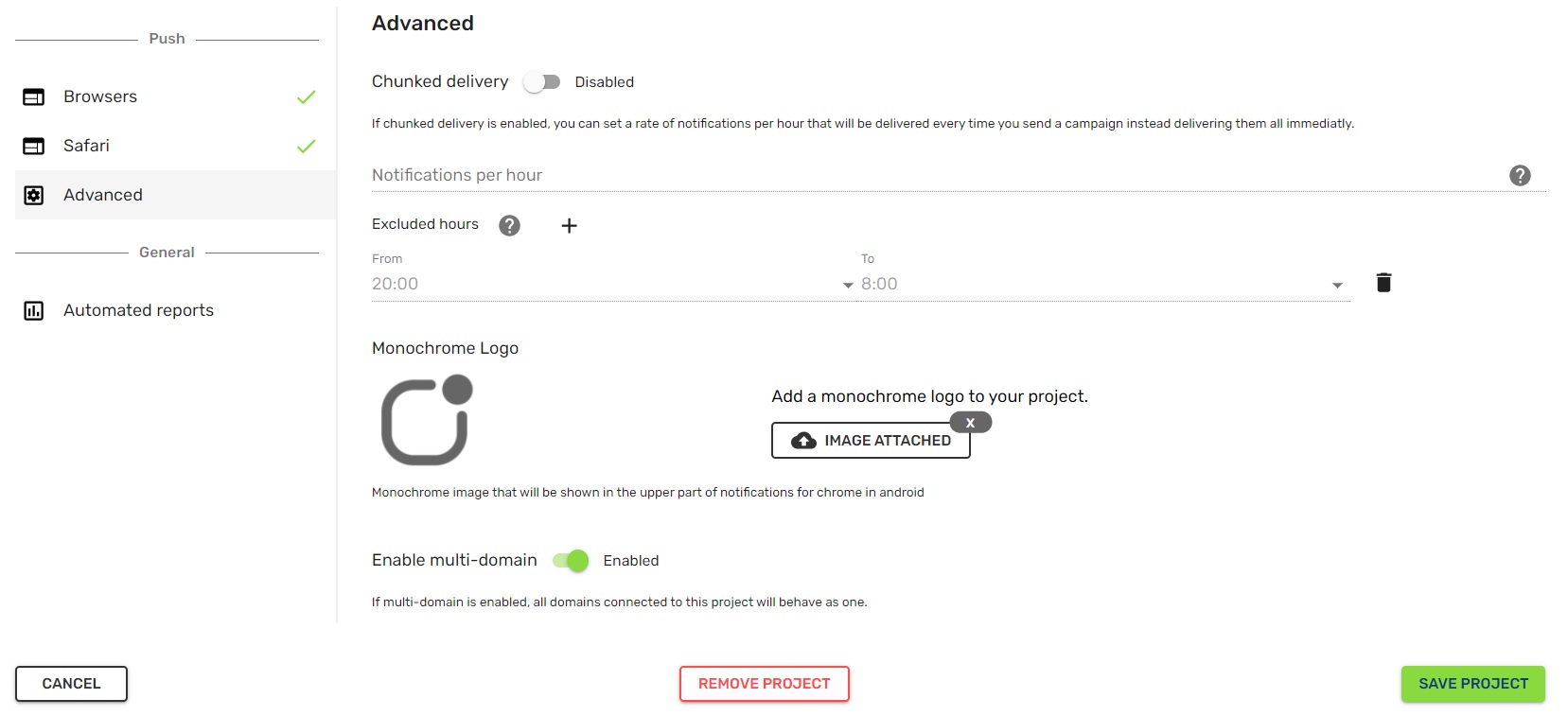
- Add a monochrome logo to your project - monochrome image that will be displayed at the top of notifications, for chrome on android.
- Enable multidomain - If you enable the multidomain option, all the domains that are connected to this project will behave as one.
App Push
Android
You need to upload the certificate by June 2024Apps using the deprecated FCM legacy APIs for HTTP and XMPP should migrate to the HTTP v1 API at the earliest opportunity. Sending messages (including upstream messages) with those APIs was deprecated on June 20, 2023, and will be removed in June 2024.
Until now to send app push notifications to android devices it was necessary a GCM/FCM Server Key provided by FCM. Now it is necessary to upload a certificate to continue sending app pushes. Please discover here how to upload this file.
For the Android platform, the fields to configure are the following:
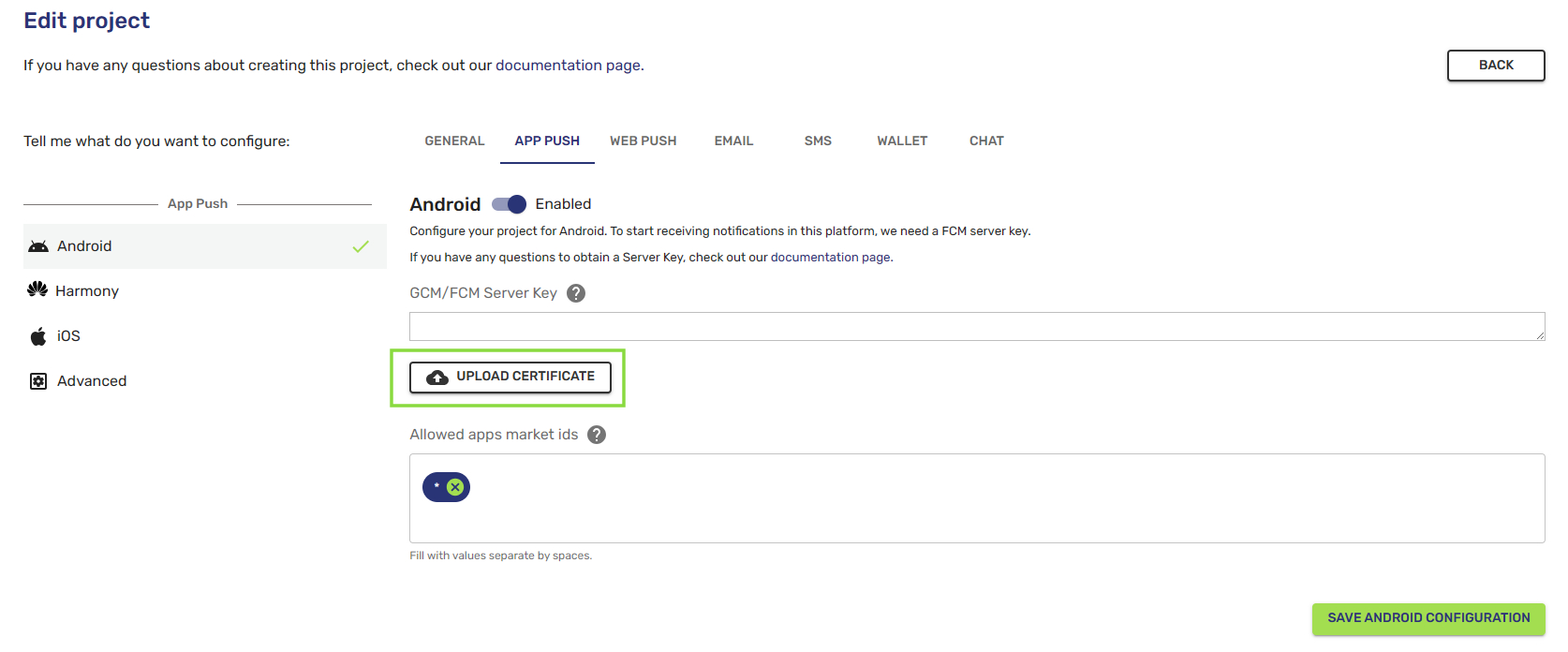
FCM Server Key: This field is no longer needed and we will remove it in the next months. Now only it is necessary to upload the certificate. (Only for your info: this key is provided by Firebase Cloud Messaging (FCM). You can register in FCM, you can follow this tutorial to discover how to do it).
NEW! Upload the Certificate: You need to upload a JSON file provided by FCM. We explain here how to obtain this certificate. Remember! It is compulsory to upload it by June 2024.
Allowed apps market ids: You can specify the market identifiers of the applications that can use your project. If this field is empty, all applications are accepted.
Harmony
For the Harmony platform, the fields to configure this platform are the following:
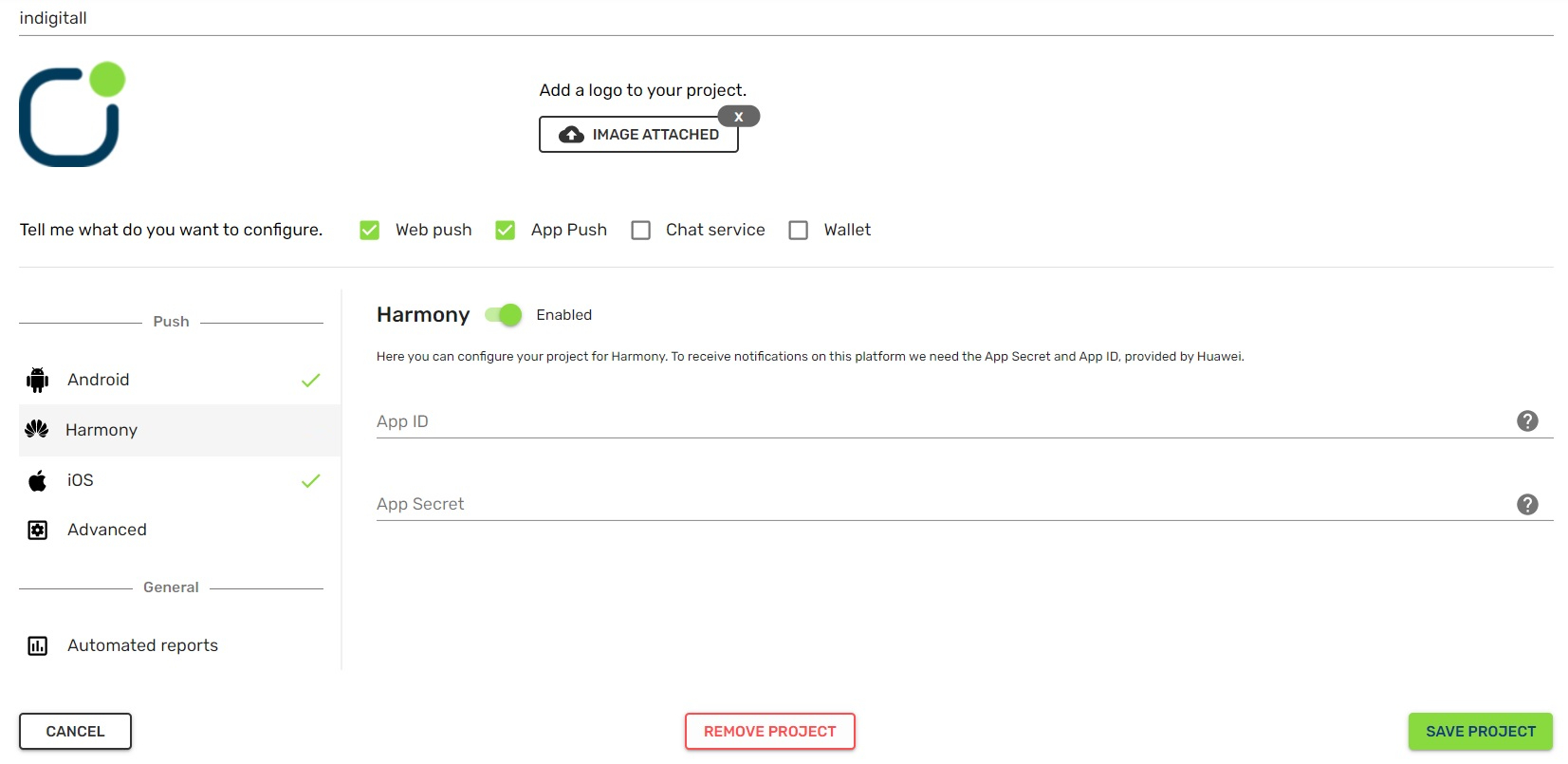
HMS Client ID - This key is provided by Huawei Mobile Services (HMS). You must register in HMS, you can follow this tutorial to learn how to do it. This field is required to receive notifications on Android.
HMS Client Secret - This key is provided by Huawei Mobile Services (HMS). You must register in HMS, you can follow this tutorial to discover how to do it. This field is required to receive notifications on Android.
iOS
For the iOS platform, the fields to configure this platform are the following:
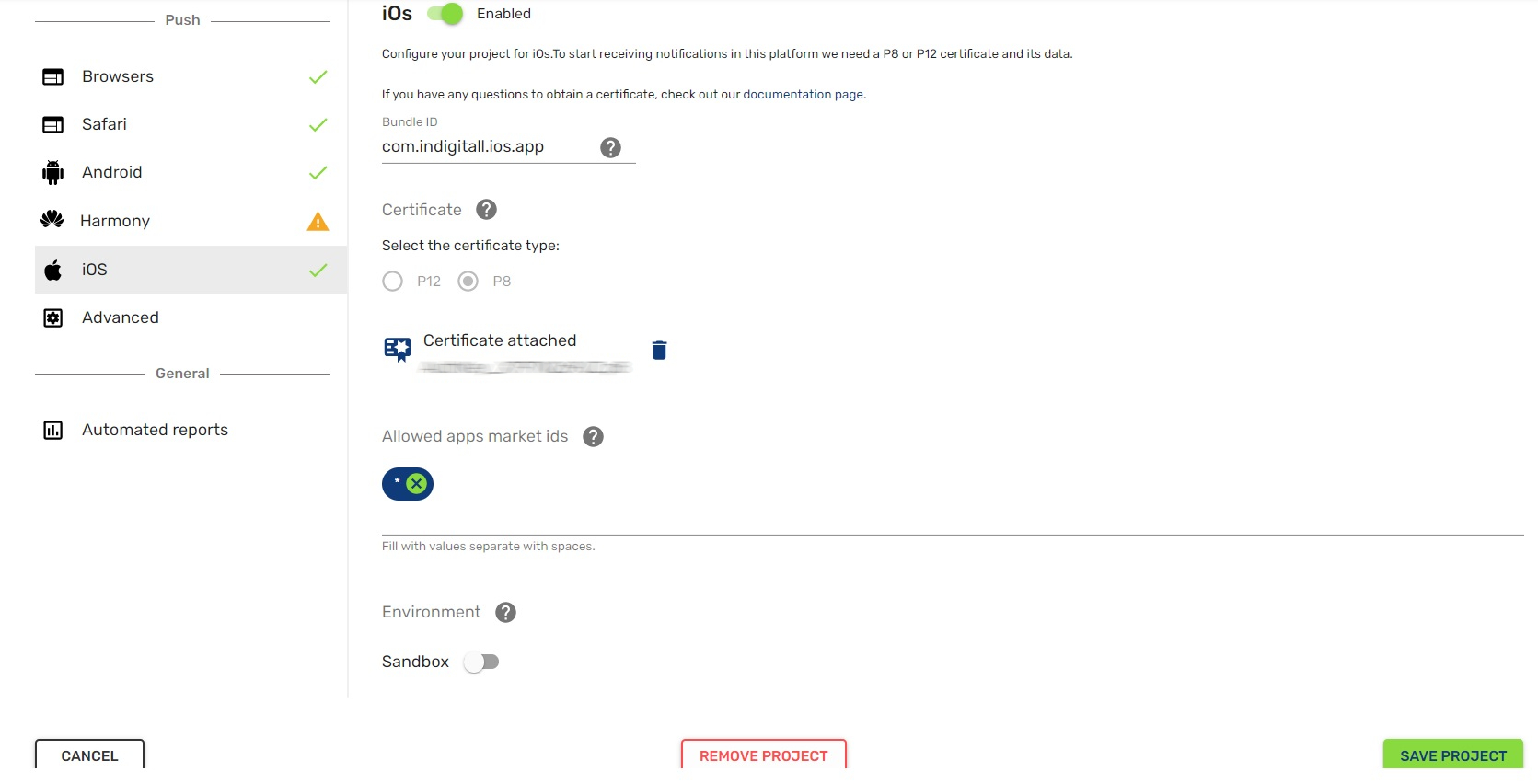
For iOS there are two possible configurations, only one is needed:
-
P12 Certificate: You must upload a P12 certificate file provided by Apple and its password if it exists, you must also provide the application package ID.
-
P8 Certificate: You must upload a P8 certificate file provided by Apple, you must also provide the Bundle ID, Team ID and Key ID application.
Advanced
In advanced area, you can use various parameters to improve the effectiveness of your notifications.
- Chunked delivery: If chunked delivery is enabled, you can set a rate of notifications per hour that will be delivered every time you send a campaign instead of delivering them immediately.
- Notifications per hour: You can set the number of notifications sent per hour. The minimum number of notifications per hour is 12,000. (Setting 12,000 notifications per hour is equivalent to sending 1,000 notifications every 5 minutes every hour).
- Excluded hours: Choose the time slot in which you do not want notifications to be sent.
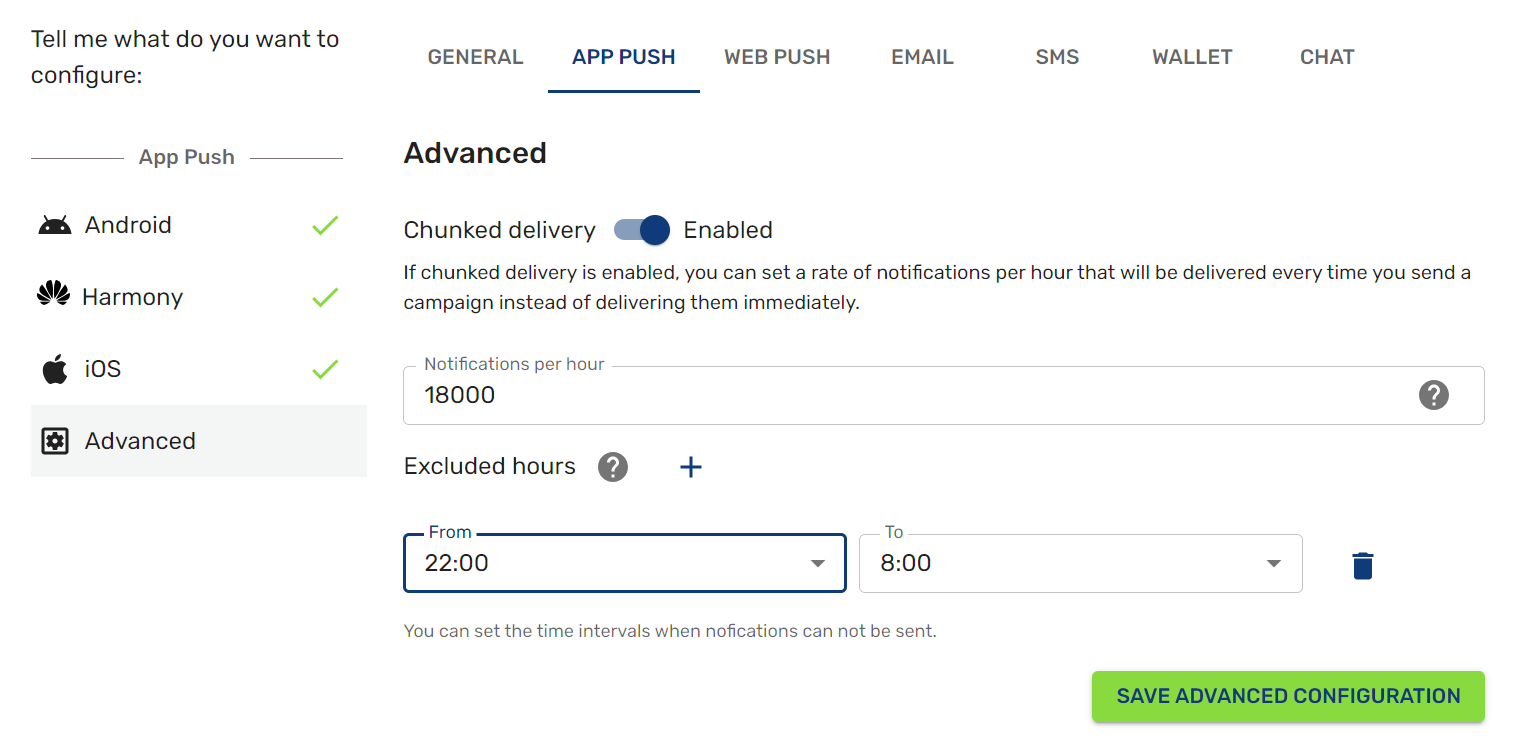
Add a monochrome logo to your project - monochrome image that will be displayed at the top of notifications, for chrome on android.
Enable multidomain - If you enable the multidomain option, all the domains that are connected to this project will behave as one.
Email
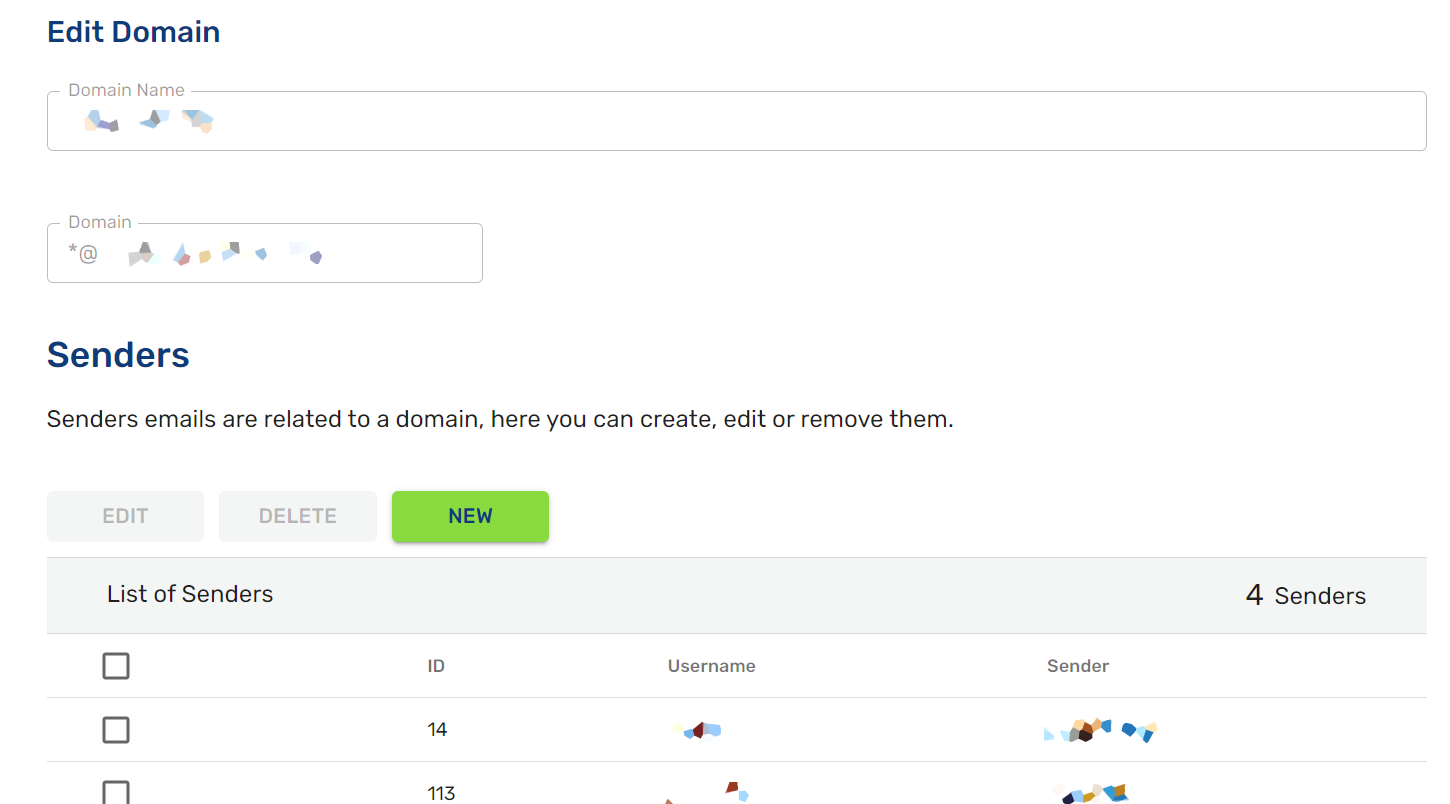
To send email campaigns, you need to create the email configuration:
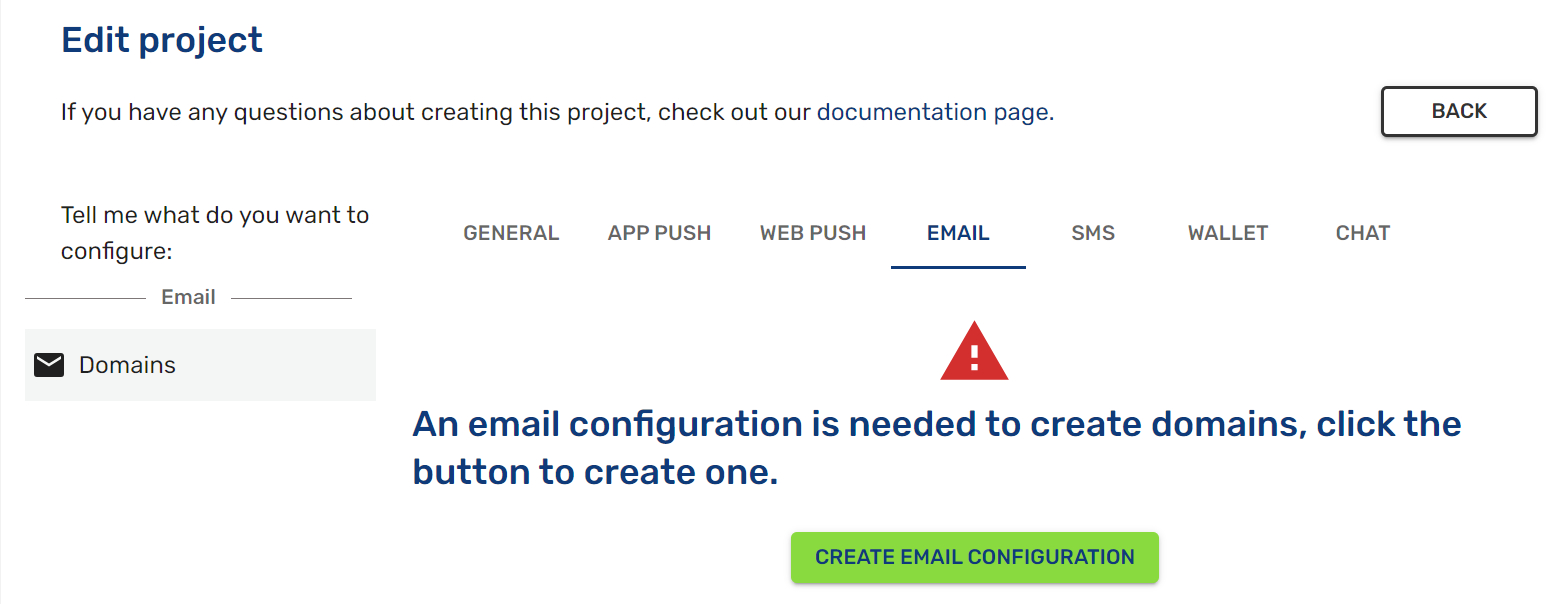
For this, you need a domain name (e.g. our_company) and the domain (e.g. indigitall.com).
Also it is possible to create the senders. The Sender or Email Sender gives information from where the email will be sent and it will appear in the field "From:" when the email is received. You can see all information here.
SMS
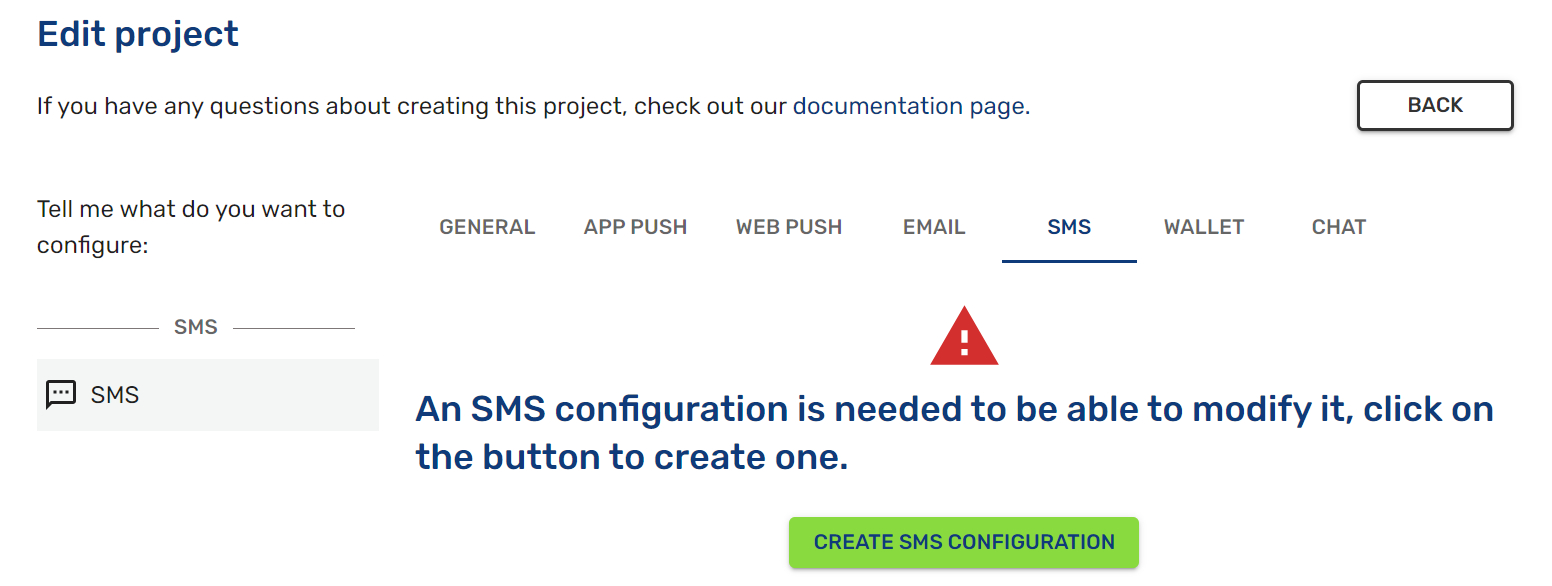
It is necessary to create the SMS configuration.
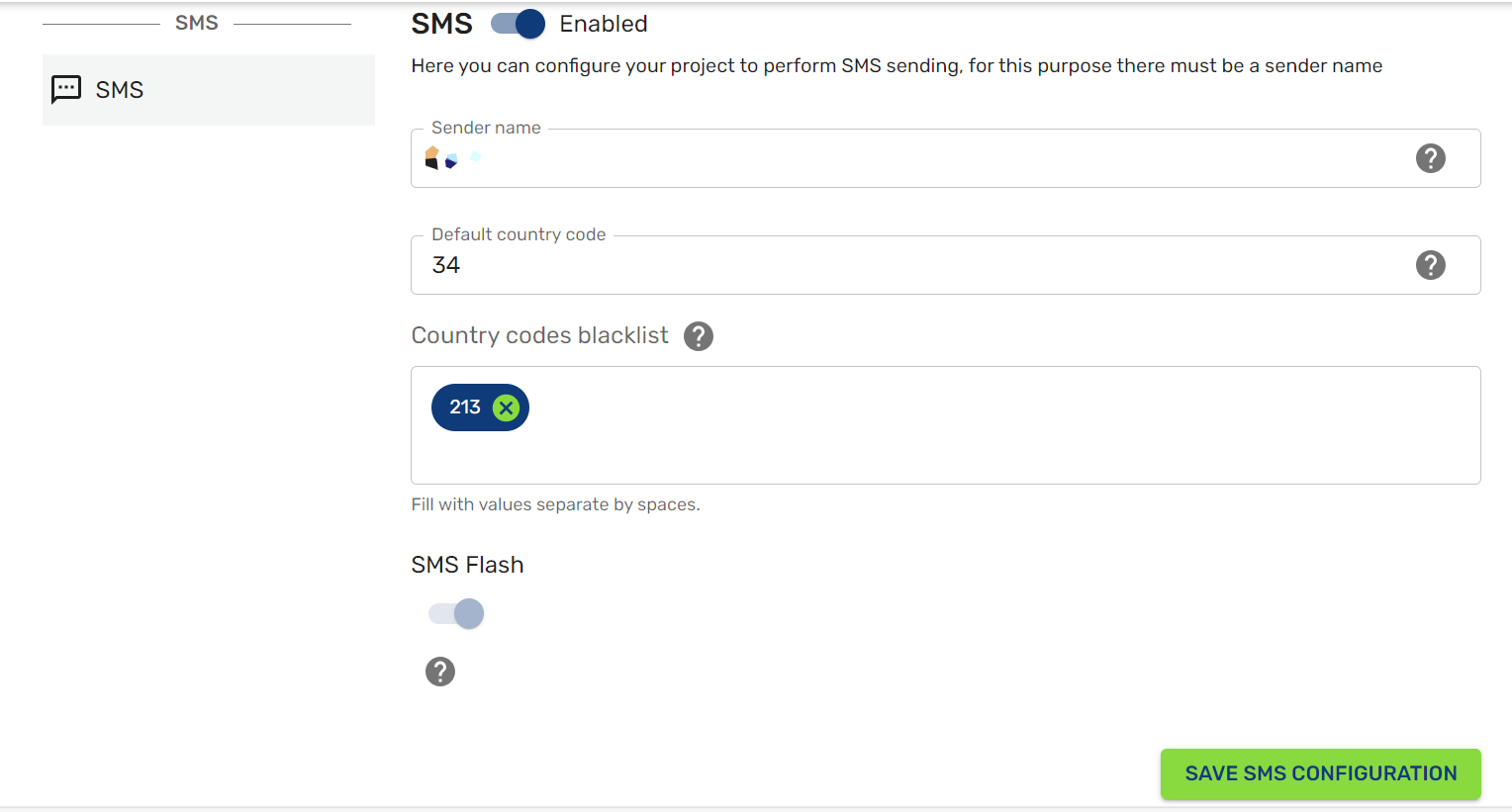
For this area, you need the following fields:
- Sender name: The sender is the name or number that the user will see as the sender of the message received.
- Default country code: The country code to send SMS.
- Country codes blacklist: Sendings will not be performed to the indicated countries.
- SMS Flash: It is displayed directly on the screen, without the need to open the SMS application.
New Chat
All Chat channel settings live under Configure > Chat V2 inside a project. Open your project, go to the top row of channel tabs (General, App Push, Web Push, Email, SMS, Chat V2, InApp/InWeb) and select Chat V2.
Inside Chat V2, a second navigation column titled Chat services lists eight sections. A green checkmark next to a section means it already has a valid, saved configuration:
| Section | What it controls |
|---|---|
| Chat service | Master switch for the channel, message throttling (chat slicing), and the AI/automation disclaimer shown to contacts |
| Auto-reply integration | A generic automatic reply sent to incoming messages |
| Contact Center Integration | Human-agent routing: concurrency limits, assignment timeouts, transfer and inactivity messages |
| Customer service schedule | Weekly working hours and holiday calendar used by the out-of-hours logic |
| Pathbot integration | Connection to indigitall's Pathbot conversational flows |
| Typebot integration | Connection to a Typebot conversational flow |
| Meta Service API integration | WhatsApp Business number registration and monthly message limits |
| Channels | Which underlying chat channel types (WhatsApp Cloud API, web chat) are active |
Each of these sections has its own Save button at the bottom of the form; saving one section does not save the others, so changes in different sections must be saved separately.
Chat service
This is the master section for the channel. It has to be enabled before any of the other Chat V2 sections can send or receive messages.
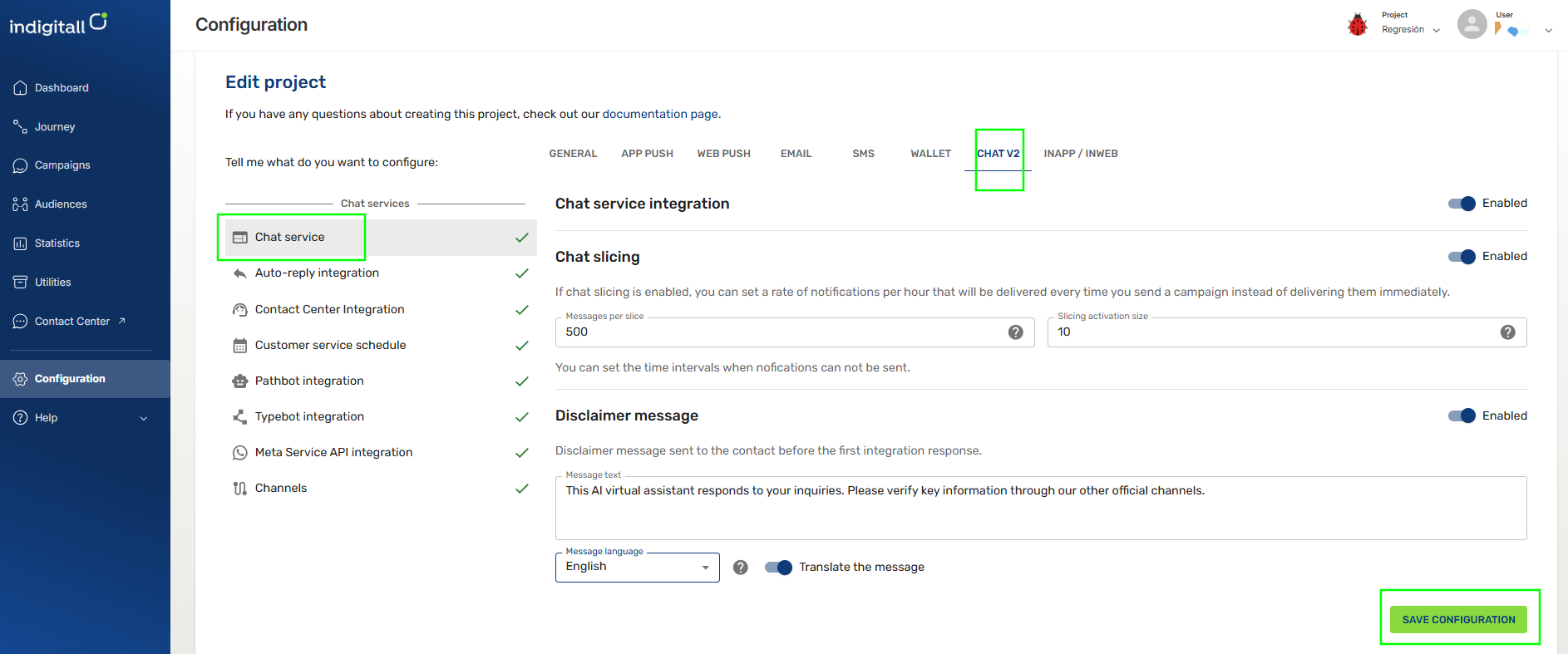
| Setting | Type | What it does |
|---|---|---|
| Chat service integration | Toggle | Turns the entire Chat channel on or off for this project. When off, none of the sections below are active, regardless of their own settings. |
| Chat slicing | Toggle | Instead of delivering every campaign message the moment it is sent, spreads ("slices") delivery over time at a controlled rate. Useful for large sends where sending everything instantly could overload agents, bots, or the underlying messaging provider. |
| Messages per slice | Number | Only shown when Chat slicing is enabled. The number of messages delivered in each slice (batch) — for example, 500. |
| Slicing activation size | Number | Only shown when Chat slicing is enabled. The minimum campaign size (number of recipients) at which slicing kicks in — for example, 10. Campaigns smaller than this are sent immediately without slicing. |
| Disclaimer message | Toggle | When enabled, sends a fixed disclaimer message to the contact before the very first automated (bot/integration) response they receive, so the person knows they are talking to an AI-assisted or automated system. |
| Message text | Text area | Only shown when the disclaimer is enabled. The disclaimer wording itself — for example, a note that a virtual assistant using AI is answering and that the contact should verify important information through other official channels. |
| Message language | Dropdown | The language the disclaimer text above is written in (for example, Spanish). This tells the platform which language to treat the message as for translation purposes. |
| Translate the message | Toggle | When enabled, the disclaimer is automatically translated into the contact's own language instead of always being sent in the language selected above. |
Click SAVE CONFIGURATION at the bottom of this section to apply changes.
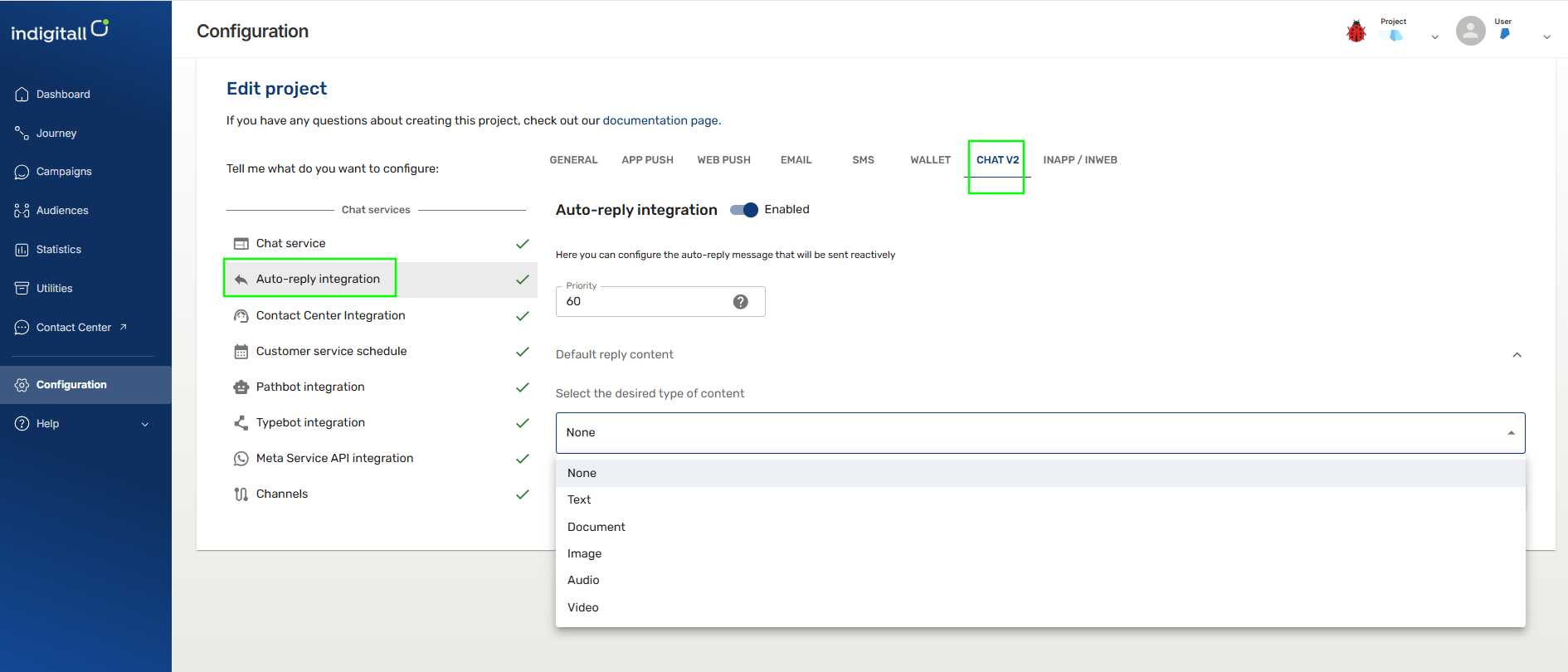
Auto-reply integration
A lightweight integration that sends a single, fixed automatic reply to incoming chat messages, without any bot logic or agent involvement.
| Setting | Type | What it does |
|---|---|---|
| Enabled | Toggle | Turns this integration on or off. |
| Priority | Number | Determines which integration answers an incoming message when more than one integration (auto-reply, Contact Center, Pathbot, Typebot) is active at the same time. A higher number means higher priority; the integration with the highest priority handles the message. Use a whole number of zero or greater, and avoid giving two integrations the same priority. |
| Default reply content — content type | Dropdown | The kind of content the auto-reply sends: None, Text, Document, Image, Audio, or Video. This same dropdown appears on every automated-message field throughout Chat V2. |
| Default reply content — Text | Text area | Shown when the content type is set to Text. The actual reply message sent to the contact. |
Click SAVE CONFIGURATION to apply changes.
Contact Center Integration
This is the largest section: it connects the chat channel to indigitall's Contact Center, where human agents handle conversations. It covers agent capacity, routing, and every automated message the system sends around an agent-handled conversation.
1) General settings
| Setting | Type | What it does |
|---|---|---|
| Enabled | Toggle | Turns the Contact Center integration on or off. |
| Priority | Number | Same concept as in Auto-reply integration: when several integrations are active, the one with the highest priority number handles incoming messages. Avoid duplicate priorities across integrations. |
| Maximum concurrent chats per agent | Number | The maximum number of conversations that can be assigned to one agent at the same time — for example, 2. Protects agents from being overloaded with simultaneous chats. |
| Contact center time zone | Dropdown | The time zone used for every time-based rule in this integration (schedules, timeouts), for example UTC+1 Europe/London. |
| Show contact code | Toggle | Displays, alongside each conversation, an identifier for the contact: the number Meta assigns for WhatsApp (similar to a phone number), or the contact's own identifier on other channels. |
2) Chat assignment
Controls how a conversation is handed to an agent, and what automated messages are sent around that handoff.
| Setting | Type | What it does |
|---|---|---|
| Timeout (minutes) | Number | The maximum time, in minutes, a contact will wait for an agent to be assigned before the "failed to assign" message (below) is triggered — for example, 5. |
| Show/Hide automated message settings | Expand link | Reveals or hides the three message blocks below; it does not change any values by itself. |
| Message after agent assignment | Content type + text | Sent to the contact once an agent has been assigned to the conversation. Uses the standard content-type dropdown (None/Text/Document/Image/Audio/Video). |
| Message after closed by agent | Content type + text | Sent to the contact when an agent manually closes the conversation. |
| Message after failing to assign to any agent | Content type + text | Sent to the contact if no agent could be assigned within the assignment timeout above. |
3) Chat Transfer
| Setting | Type | What it does |
|---|---|---|
| Message after transfer to another agent | Content type + text | Sent to the contact when their conversation is handed from one agent to a different one. |
4) Outside customer service hours management
These settings define what happens when a contact writes outside the hours defined in the Customer service schedule section (covered later in this guide).
| Setting | Type | What it does |
|---|---|---|
| Unattended contacts list | Dropdown | A contact list that every user who writes outside the configured service hours is automatically added to, so those contacts can be followed up on later (for example, with a campaign). |
| Empty contact list after sending | Toggle | When enabled, the unattended contacts list above is cleared out automatically once a message or campaign has been sent to it. |
| Message when outside customer service hours | Content type + text | Sent automatically to a contact who writes outside the configured service hours. |
5) Chat inactivity
Controls how the system handles a conversation that has gone quiet.
| Setting | Type | What it does |
|---|---|---|
| Enabled | Toggle | Turns on automatic closing of inactive conversations. |
| Timeout (minutes) | Number | How long a conversation can sit with no new messages before it is automatically closed — for example, 30 minutes. |
| Inactivity reference mode | Dropdown | Which side's messages count as "activity" and reset the inactivity timer: Both (a message from either the agent or the contact keeps the chat open), Agent (only the agent's replies keep it open), or Contact (only a message from the customer keeps it open). |
| Message after automatic close by inactivity | Content type + text | Sent to the contact when the conversation is closed automatically for inactivity. |
All of these settings are saved together with the rest of Contact Center Integration using the SAVE CONFIGURATION button.
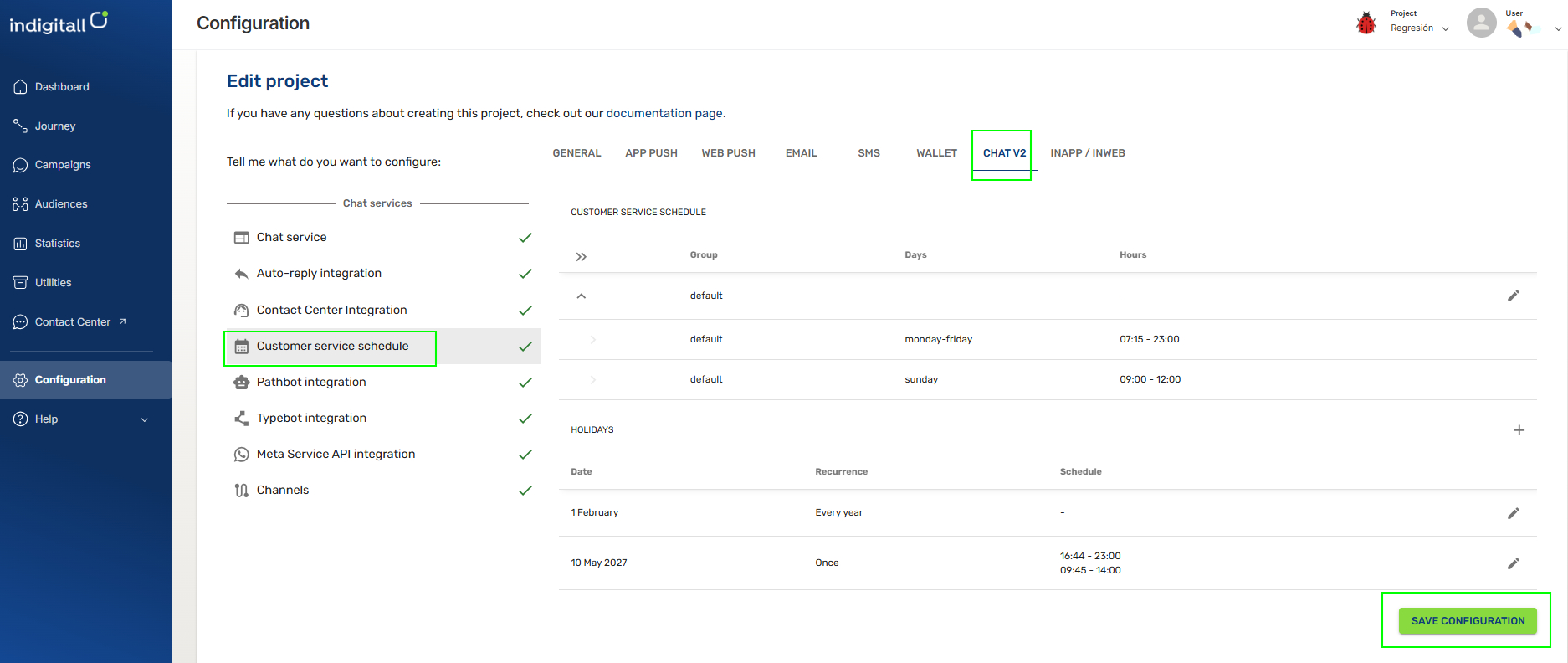
Customer service schedule
This section defines exactly when human customer service is considered "in hours." Outside these windows, the "Message when outside customer service hours" (Contact Center Integration) is sent instead of routing to an agent.
1) Weekly schedule table
A table with columns Group, Days, and Hours. Each row is one time block, for example a group covering Monday–Friday from 07:15 to 23:00, and a separate group covering Sunday from 09:00 to 12:00. An expand/collapse control at the top of the table shows or hides all rows at once, and rows can be selected with their checkboxes for bulk deletion.
Clicking the pencil icon on a row opens the Edit week days dialog:
| Field | Type | What it does |
|---|---|---|
| Day chips (e.g. Monday, Tuesday...) | Multi-select chips | The days this group of hours applies to. Days can be added or removed individually. |
| From / To | Time pickers | The start and end time of a service window on the selected days. |
| + Add another time slot | Link | Adds a second (or further) time window to the same group of days — useful for a split schedule such as morning and afternoon shifts. |
| + Add days group | Button | Creates an additional group of days with its own independent hours, alongside the current one. |
| Save schedule | Button | Saves the changes made in this dialog. |
2) Holidays table
A separate table with columns Date, Recurrence, and Schedule, listing exceptions to the weekly schedule above — for example, a fixed holiday every year, or a specific one-off date with its own reduced hours. New entries are added with the + Add item button; existing ones are edited via the pencil icon, which opens the Edit holiday dialog:
| Field | Type | What it does |
|---|---|---|
| Recurring date (disabled every year) | Toggle | When enabled, this date is treated as recurring on the same day/month every year (for example, a fixed public holiday) rather than a single specific year. |
| Day / Month | Number + dropdown | The calendar date of the holiday. |
| + Add time range | Link | Adds a service-hours window for that date. Leaving no time range at all means the business is fully closed that day. |
| Save | Button | Saves the holiday entry; disabled until the entry is valid. |
After editing either table, click SAVE CONFIGURATION to persist the schedule.
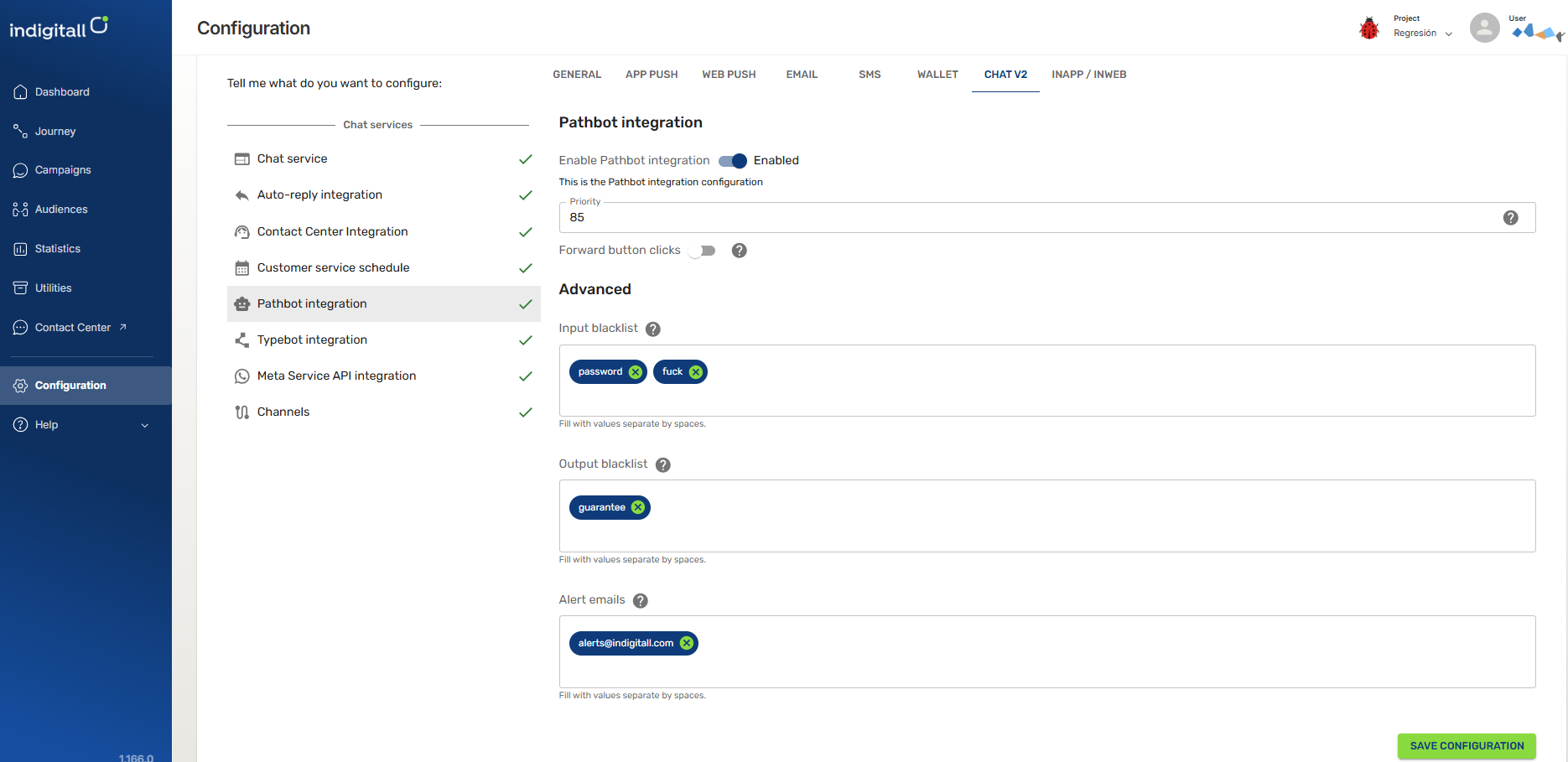
Pathbot integration
Connects the chat channel to an indigitall Pathbot conversational flow.
| Setting | Type | What it does |
|---|---|---|
| Enable Pathbot integration | Toggle | Turns the Pathbot connection on or off. |
| Priority | Number | Same priority logic as the other integrations: the highest number among active integrations handles the incoming message. |
| Forward button clicks | Toggle | When enabled, clicks on interactive buttons inside the bot flow are forwarded to Pathbot as events, rather than only being handled inside the chat UI. |
| Input blacklist | Tag list | Words that, if the contact writes them, are blocked from being sent to the bot. Enter values separated by spaces. |
| Output blacklist | Tag list | Words that are blocked from what the bot is allowed to say back to the contact. Enter values separated by spaces. |
| Alert emails | Tag list | Email addresses that receive automatic alerts about the cost of running this integration. |
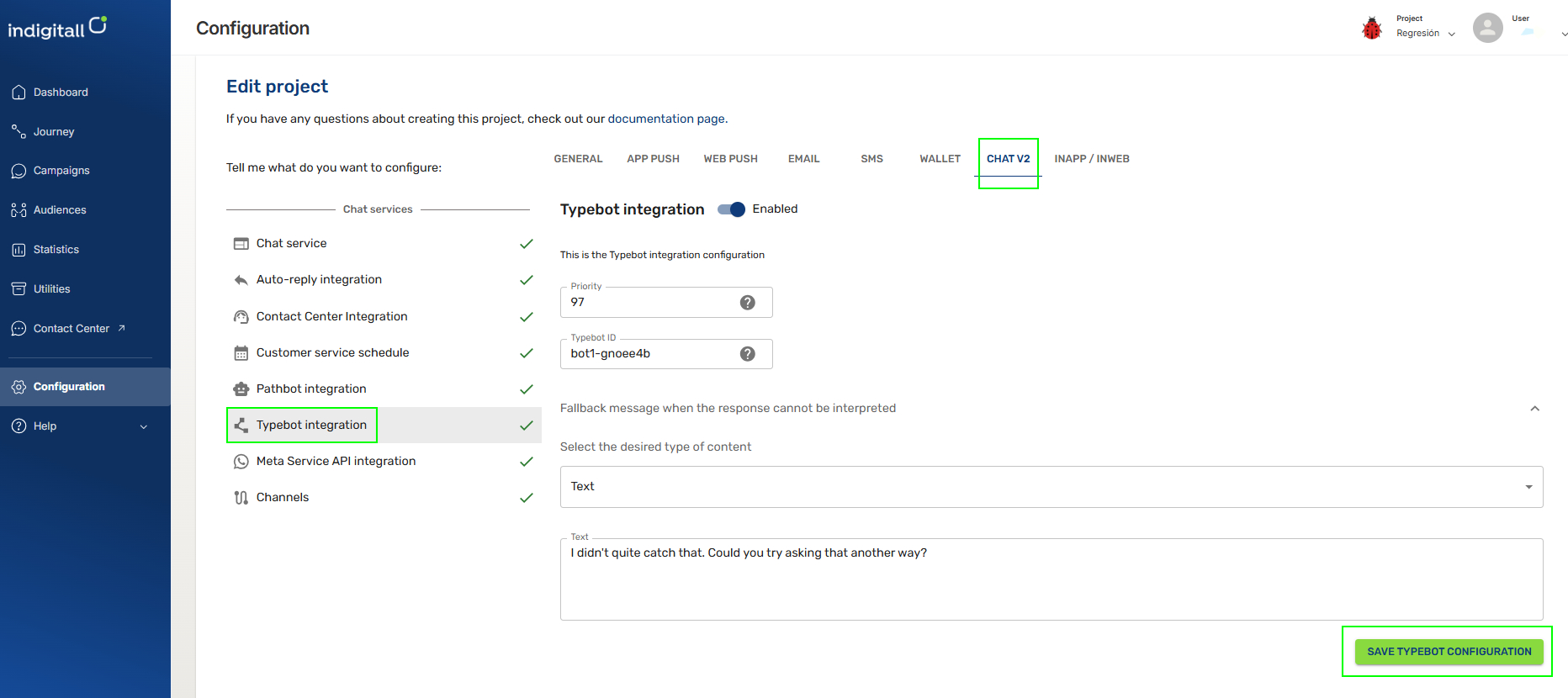
Typebot integration
Connects the chat channel to a Typebot conversational flow.
| Setting | Type | What it does |
|---|---|---|
| Enabled | Toggle | Turns the Typebot connection on or off. |
| Priority | Number | Same priority logic as the other integrations. |
| Typebot ID | Text | The identifier of the specific Typebot flow to use for this integration. |
| Fallback message when the response cannot be interpreted | Content type + text | Sent to the contact whenever Typebot returns a response the platform cannot parse or understand. |
Meta Service API integration (WhatsApp)
This section covers the WhatsApp Business number connected to the project through Meta's API.
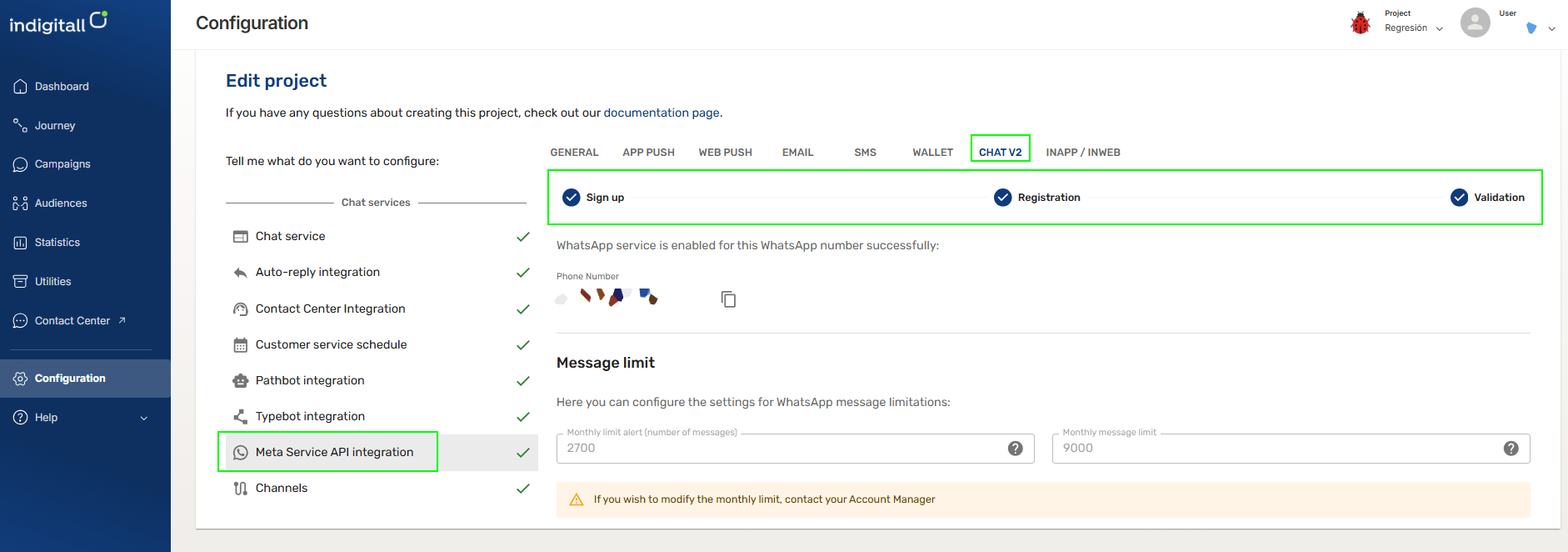
A three-step progress indicator at the top shows the registration status of the number:
- Sign up: The initial phase where you express interest in the service. To begin, you must contact the indigitall support department to register the WhatsApp service for your specific project.
- Registration: During this stage, your official business data and phone number are submitted for review.
- Validation: The final phase where Meta verifies your business identity to grant full access to the API.
Once all three steps show as completed, a confirmation line states that the WhatsApp service is enabled for that number, and the number itself is displayed with a copy-to-clipboard button next to it.
Message limit
These two fields let you configure protections around WhatsApp's own monthly message limits:
| Setting | Type | What it does |
|---|---|---|
| Monthly limit alert (number of messages) | Number | Once the number of messages sent in a month reaches this value, an alert email is sent so the team can react before hitting the hard limit — for example, 2,700. |
| Monthly message limit | Number | The hard monthly cap. Once reached, the WhatsApp service is interrupted for the rest of the month and an informative email is sent — for example, 9,000. |
A warning notice on this screen reminds customers that if they need to change the monthly limit itself, they should contact their Account Manager rather than trying to edit it here.
Channels
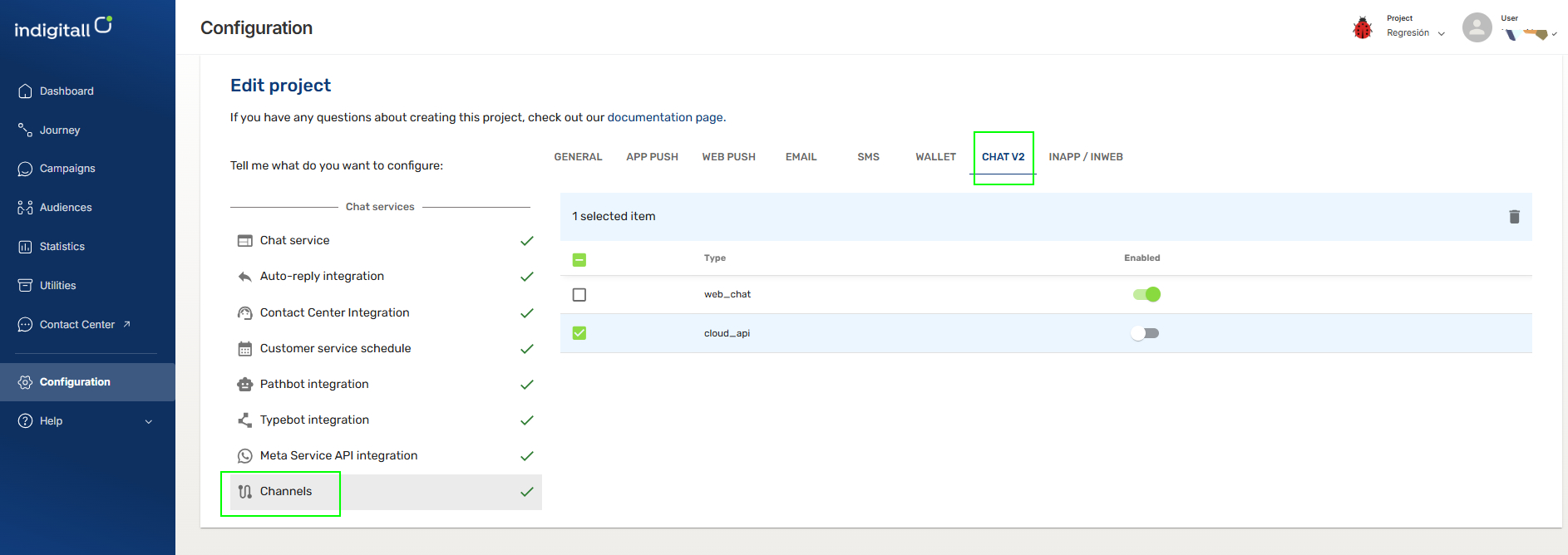
A simple table listing which underlying chat channel types are active for this project, with columns Type and Enabled.
Each row has its own Enabled toggle. New channel types can be added with the + button above the table, and rows can be selected with their checkboxes for bulk removal.
Chat v1
The Chat tab serves as your central command center for managing and activating real-time communication channels. As an official Meta Business Partner, we provide a streamlined, end-to-end experience to help you integrate and scale WhatsApp Business API services, from initial setup to global deployment.

This section is organized into specific integration modules to ensure seamless, reliable connectivity between your business and your customers. Using the left-hand sidebar, you can access and manage the core components of your chat ecosystem:
Chat Service
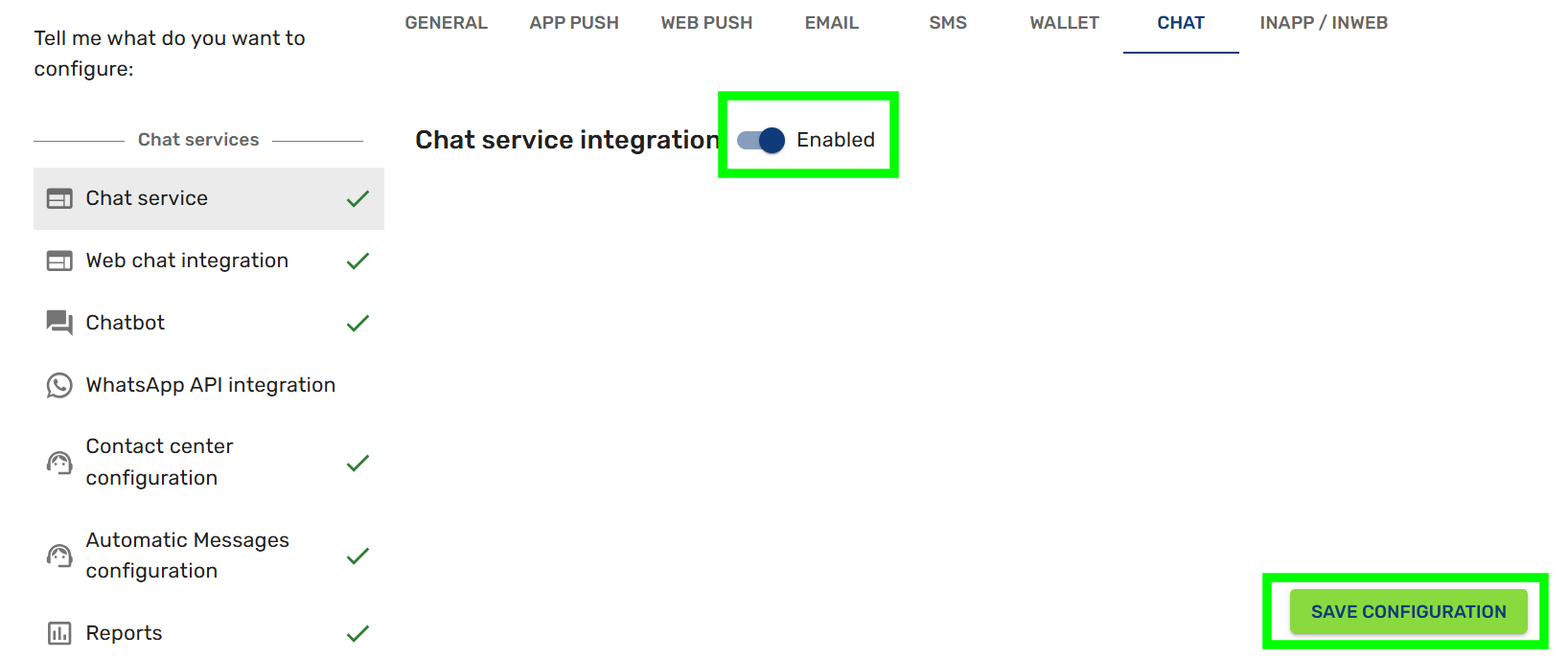
Use the primary toggle to enable or disable chat functionality across your system. When set to Enabled, the service becomes active and ready for further configuration.
- Important: Saving Your Changes
After filling out the required fields in any sub-section, you must click the green "SAVE CONFIGURATION" button located at the bottom right of the screen. This button is present across all configuration pages and is essential to apply your changes and successfully complete the verification process.
Web Chat Integration
The Web Chat Integration section allows you to deploy and customize a live chat widget directly on your website or customer portal. This tool is essential for providing real-time support and engaging with your visitors instantly.
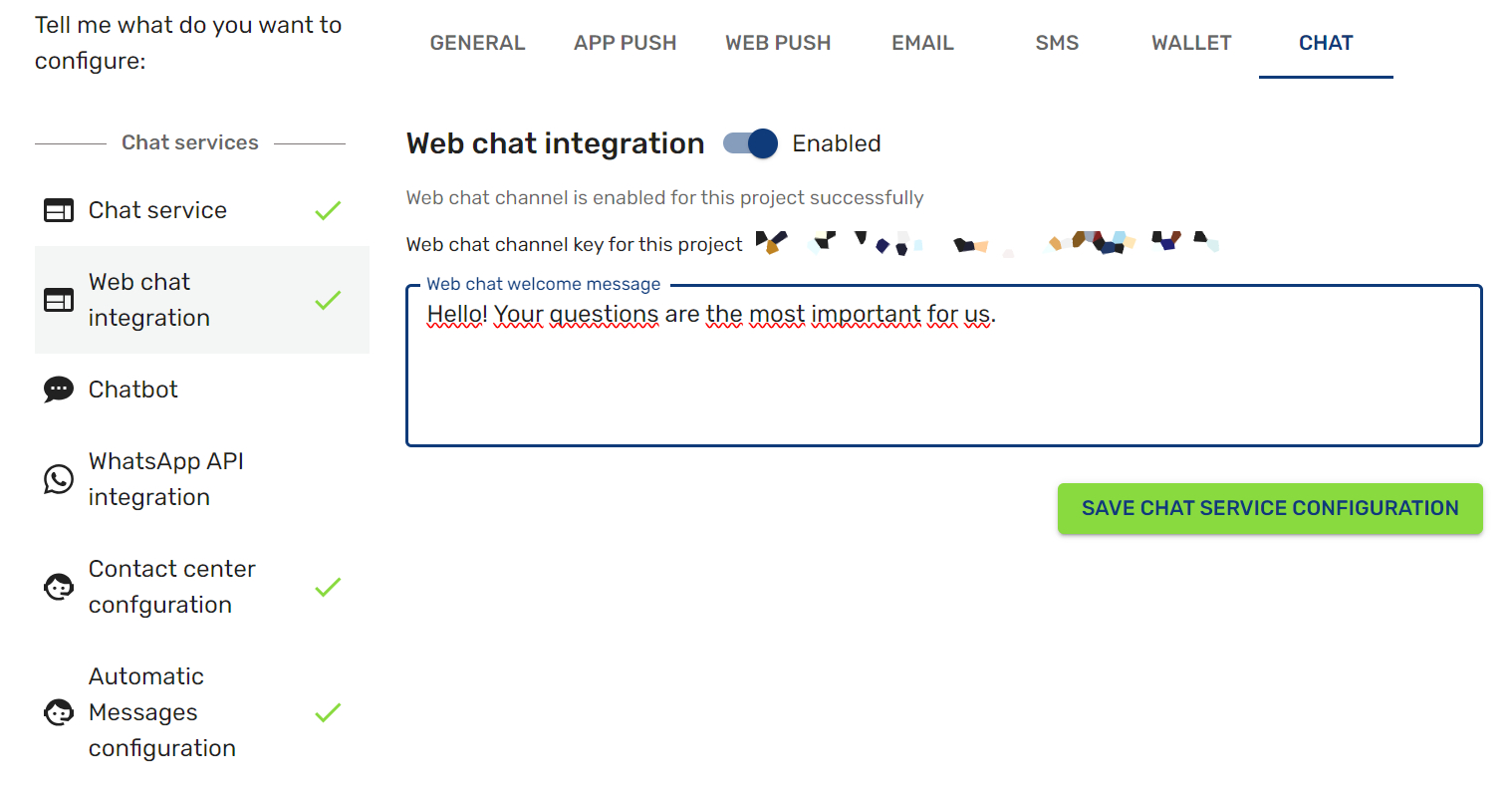
Once you select this option from the sidebar, you can manage the following elements:
- Status Toggle: Use the Web chat integration switch to enable or disable the channel for your specific project.
- Web Chat Channel Key: This unique identifier is generated automatically once the service is enabled, allowing you to link the chat service to your web environment.
- Welcome Message: You can personalize the initial greeting that users see when they open the chat. For example: "Hello! Your questions are the most important for us."
Chatbot Configuration
The Chatbot section allows you to integrate automated intelligence into your communication channels. You can choose between a standard structured bot or a more advanced Generative AI agent to handle customer interactions.
Depending on your needs, you can select from the following service types:
-
None: Select this if you do not have an active bot.
-
Dialogflow: Select this if you are using a bot with predefined options (static conversation flows). The configurable fields are:
- Dialogflow Project ID: The unique project identifier (provided by indigitall).
- Dialogflow Credentials: The authentication credentials required to access the project (provided by indigitall).
- Default Language: The primary language used by the bot.
- Priority: Defines the processing priority. Enter a whole number greater than or equal to zero. Note: The higher the number, the higher the priority. -
AI Agent: Select this to configure a Generative AI agent. You must complete the following fields to define its behavior:
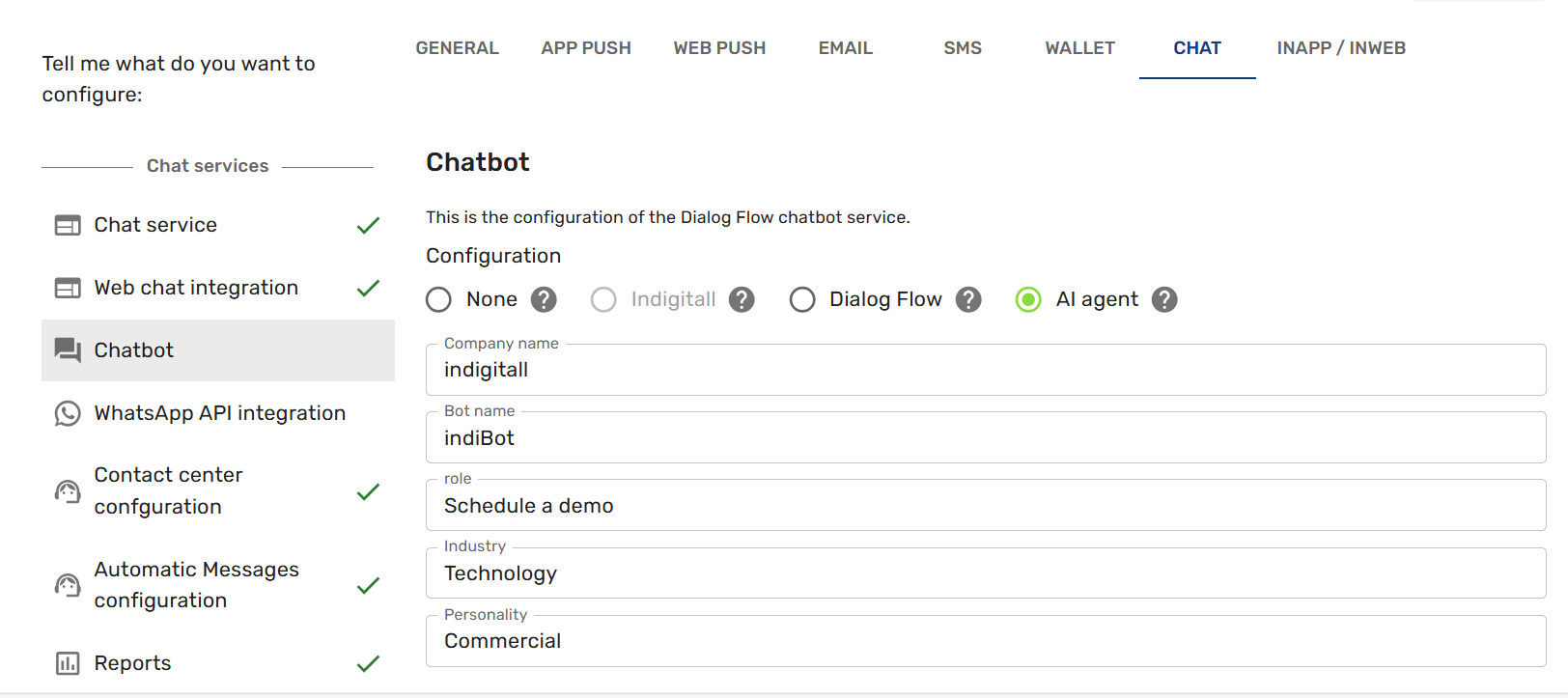
- Company Name: Your organization's name.
- Bot Name: The display name for your agent.
- Role: The primary goal of the bot (e.g., Customer Support, Sales, Lead Gen).
- Industry: The business sector to provide context for the bot.
- Personality: The specific tone the bot should use (e.g., Commercial, Professional, Casual).
- Advanced Settings. The following fields are optional but recommended for safety and monitoring:
- Input Blacklist: A comma-separated list of trigger words. If a user includes any of these words in their message, the bot will block the interaction and will not provide a response.
- Output Blacklist: A comma-separated list of prohibited words. The bot is strictly prevented from using any of these terms in its responses.
- Alert Email: Designate email addresses to receive system notifications regarding service costs.
To complete your chatbot configuration and ensure all your settings are applied, pay close attention to the action buttons located at the bottom of the section.
Managing Chatbot Memory
As with all other sections in the platform, you will find a green button at the bottom right:
- SAVE CONFIGURATION: Clicking this button is essential to verify your steps and store all the data you have entered. Always click this button before navigating away from the page to avoid losing your progress.
To the left of the save button, there is an additional option that requires careful handling:
- SAVE AND RESET MEMORY: This button saves your current settings but simultaneously wipes the chatbot's existing memory.
>> Use with Caution: Clicking this will cause the bot to "forget" previous interactions and context immediately. This can lead to unexpected behavior or disruptions in ongoing customer conversations. Only use this option if you specifically intend to restart the bot's learning or context from scratch.

WhatsApp API Integration
The WhatsApp API Integration section guides you through the official process of connecting your business to the WhatsApp ecosystem. As a Meta Business Partner, we facilitate this multi-step verification to ensure your channel is fully compliant and ready for high-volume messaging.
The setup is divided into three critical phases, which you can track at the top of the interface:
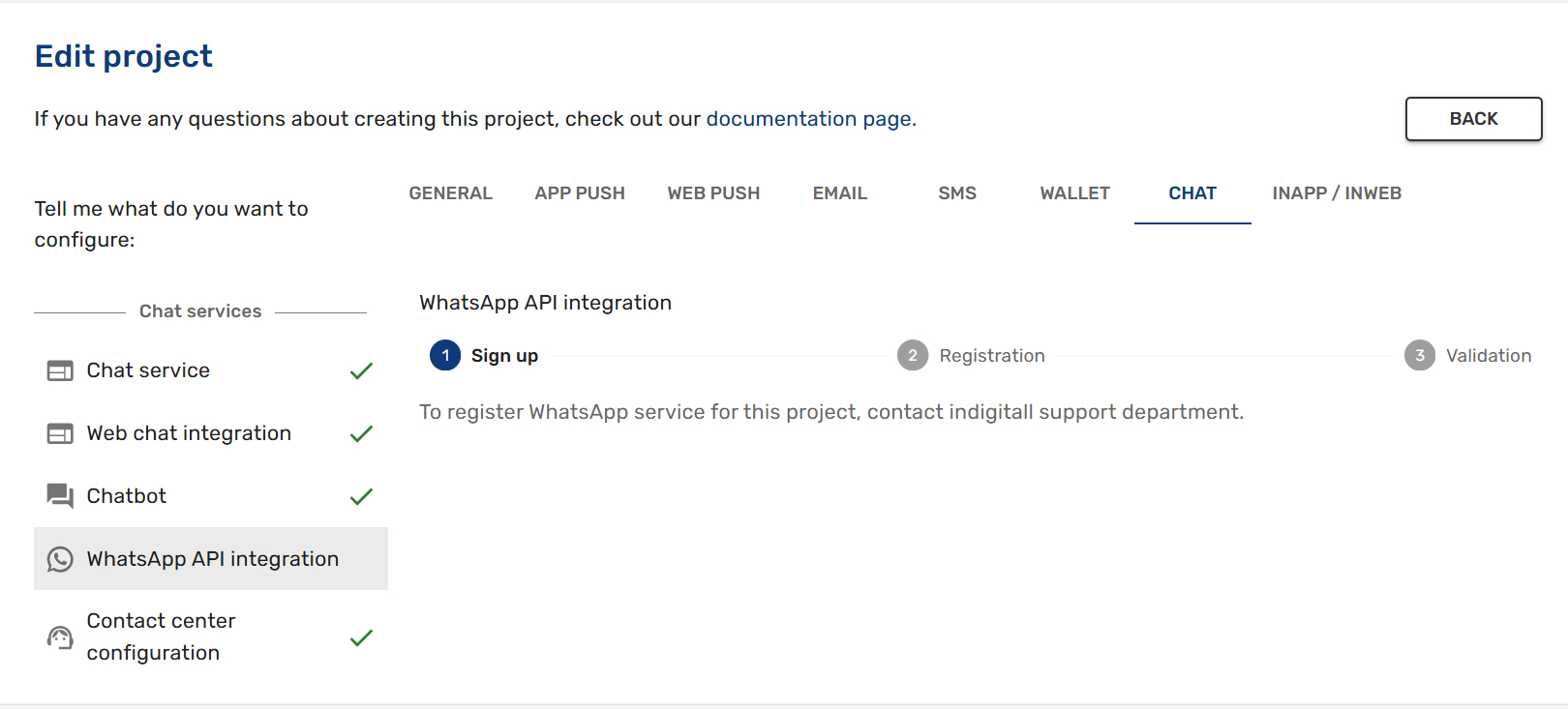
- Sign up: The initial phase where you express interest in the service. To begin, you must contact the indigitall support department to register the WhatsApp service for your specific project.
- Registration: During this stage, your official business data and phone number are submitted for review.
- Validation: The final phase where Meta verifies your business identity to grant full access to the API.
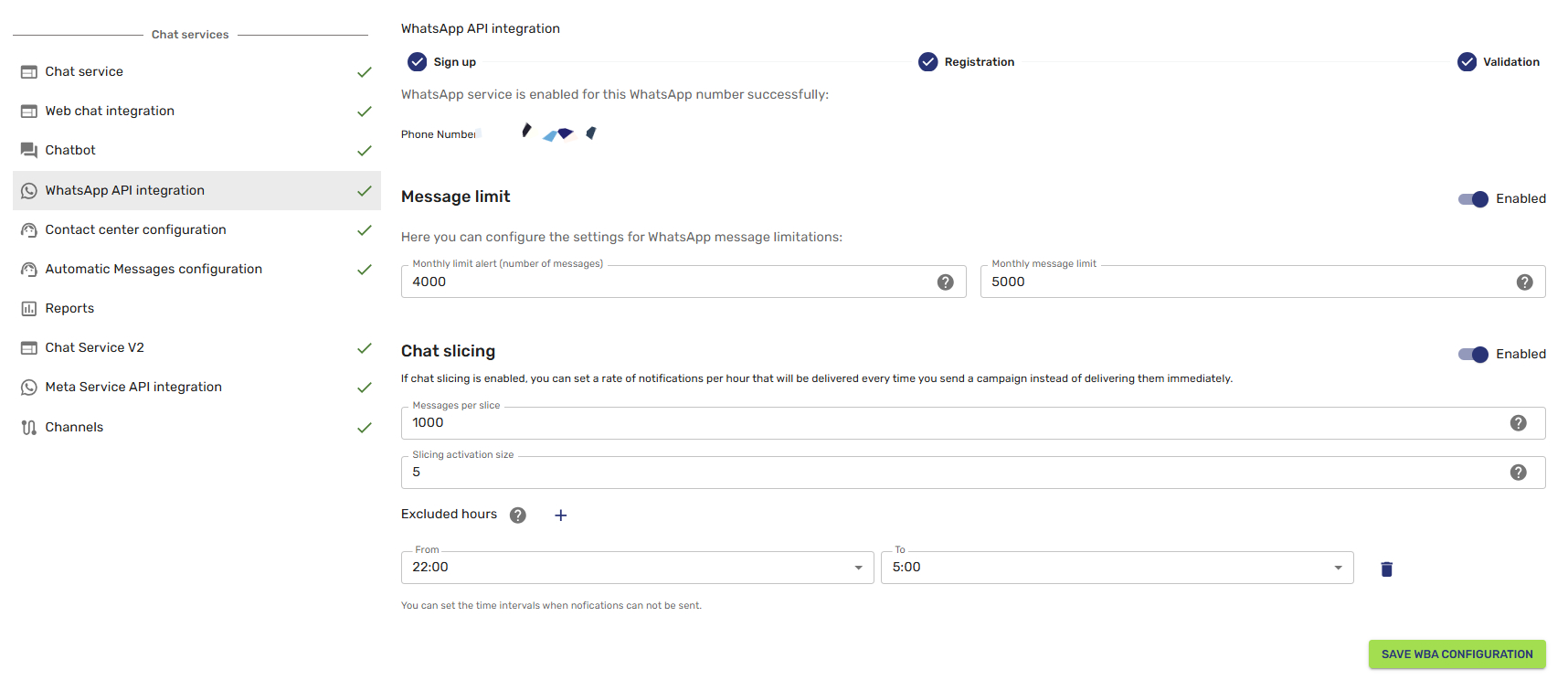
Once your WhatsApp number is successfully enabled and has passed the Sign-up, Registration, and Validation phases, you can fine-tune your messaging operations through the following advanced settings.
Message Limit
This section allows you to manage your messaging volume to control costs or adhere to specific campaign limits:
- Message Limit Toggle: Enable or disable global message limitations for your WhatsApp channel.
- Monthly Limit Alert: Set a specific threshold (number of messages) at which the system will trigger an alert notification.
- Monthly Message Limit: Define the absolute maximum number of messages that can be sent through this channel per month.
Chat Slicing
If enabled, Chat Slicing allows you to stagger the delivery of your messages rather than sending them all at once. This is particularly useful for managing inbound traffic to your call center:
- Messages per Slice: Define the number of notifications to be delivered in each hourly interval.
- Slicing Activation Size: Set the minimum campaign size required to trigger the slicing mechanism.
Excluded Hours
To respect customer rest times or operational hours, you can define specific periods when notifications will not be sent:
- Time Intervals: Use the "From" and "To" selectors to set a blackout period (e.g., 22:00 to 5:00) during which all outgoing messaging will be paused.
Contact Center Configuration
The Contact Center Configuration section allows you to manage the operational parameters for your live support agents. By fine-tuning these settings, you can optimize response times and ensure a balanced workload across your support team.
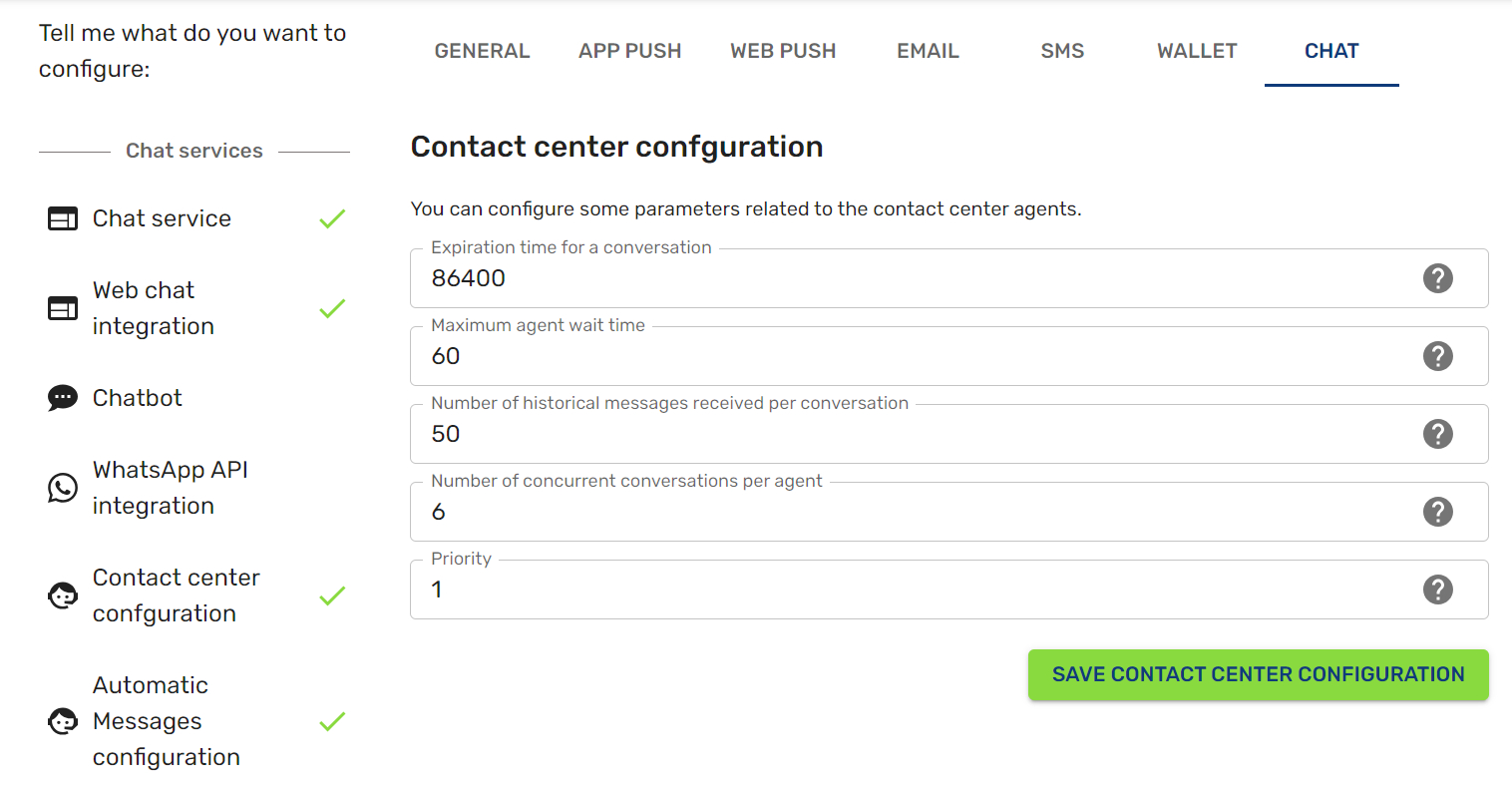
You can customize the following fields to match your team's workflow:
- Expiration time for a conversation: This defines the duration (in seconds) after which a conversation will expire. The minimum allowed time is 300 seconds (5 minutes), and the system defaults to 86400 (1 day).
- Maximum agent wait time: Sets the maximum time a user will remain in the queue waiting for an available agent.
- Number of historical messages received per conversation: Determines how many previous messages an agent can view once a conversation is assigned to them. While the default is 20, you can adjust this to provide more context to your team.
- Number of concurrent conversations per agent: Limits the maximum number of active chats assigned to a single agent at any given time. The default value is 6.
- Priority: Use a whole number (0 or higher) to define the processing priority of this configuration. Note: Higher numbers indicate higher priority.
Automatic Messages Configuration
Within the Chat tab, you have full control over how your system interacts with users through automated responses and scheduled availability. This section allows you to customize the Automated messages for the contact center, where you can define triggers for agent transfers and closures, and manage Automatic AI Agent Messages to maintain a consistent voice for your generative bot. Additionally, you can configure Customer service hours to manage user expectations and ensure your team is only assigned conversations during active operational windows.
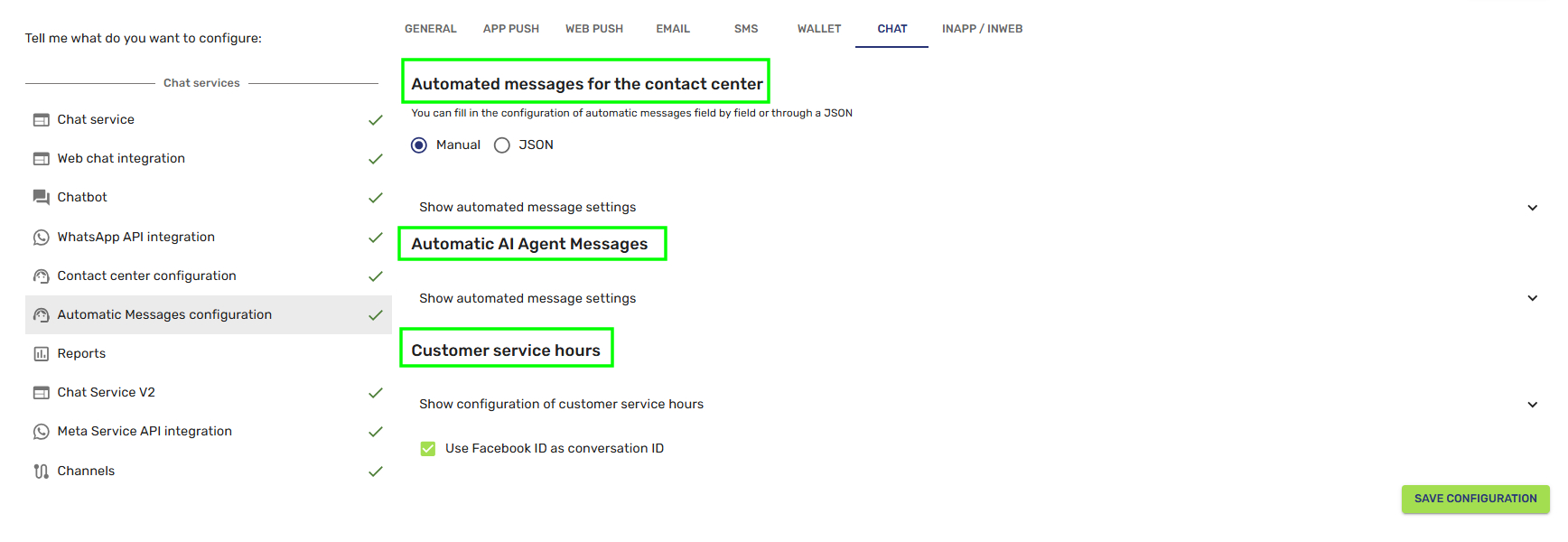
1. Automated messages for the contact center
The Automated messages for the contact center section allows you to define how the system communicates with users during key moments of the support journey. You can configure these responses using two primary methods:
- Manual: Select this option to fill in each message field individually using the provided interface.
- JSON: Select this option to input your instructions directly via a code field, which is ideal for advanced configurations or bulk updates.
Customizable Notification Triggers
You can set up specific notifications to keep users informed during the following events:
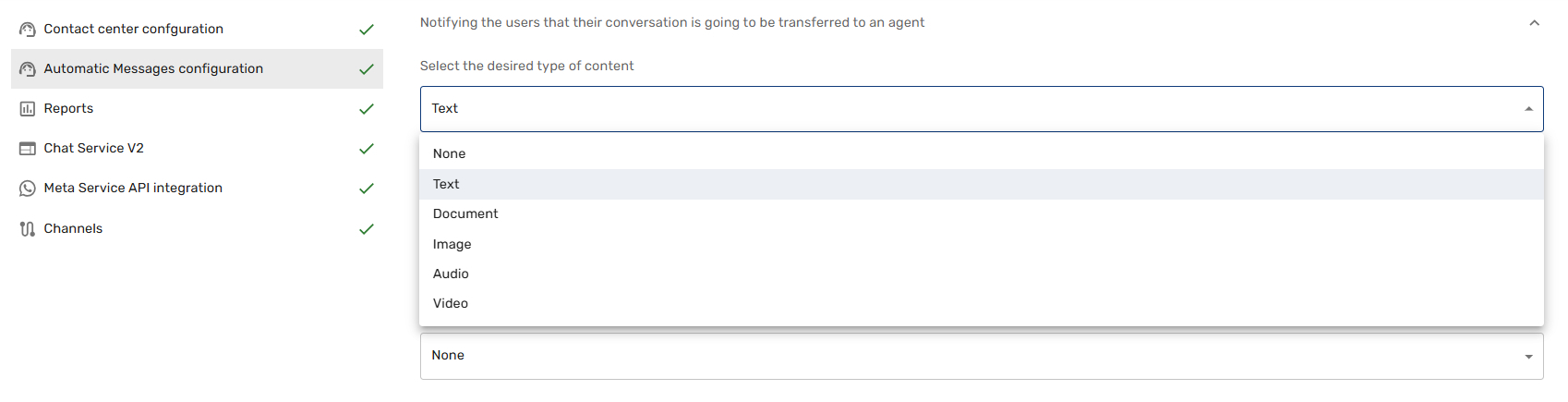
- Initial Transfer: Notify users when their conversation is being moved to a support agent.
- Assignment: Inform users once an agent has successfully been assigned to their chat.
- Reassignment: Alert users when their session is being transferred to a different agent.
- Assignment Failure: Notify users if the system is unable to find an available agent.
- Transfer Success: Confirm that a transfer to a live agent was completed successfully.
- Transfer Failure: Alert users if a move to another agent could not be completed.
- Automatic Closure: Notify users when a session ends automatically due to inactivity or system rules.
- Agent Closure: Inform users when an agent manually ends the conversation.
Multi-Media Support
For every field mentioned above, you have the flexibility to choose the type of content the user receives:
- Available Formats: None (no message), Text, Document, Image, Audio, or Video.
2. Automatic AI Agent Messages
The Automatic AI Agent Messages section provides granular control over how your Generative AI assistant communicates during specific system events. This ensures that even when the bot encounters technical limitations or specific triggers, it maintains a professional and consistent brand voice.
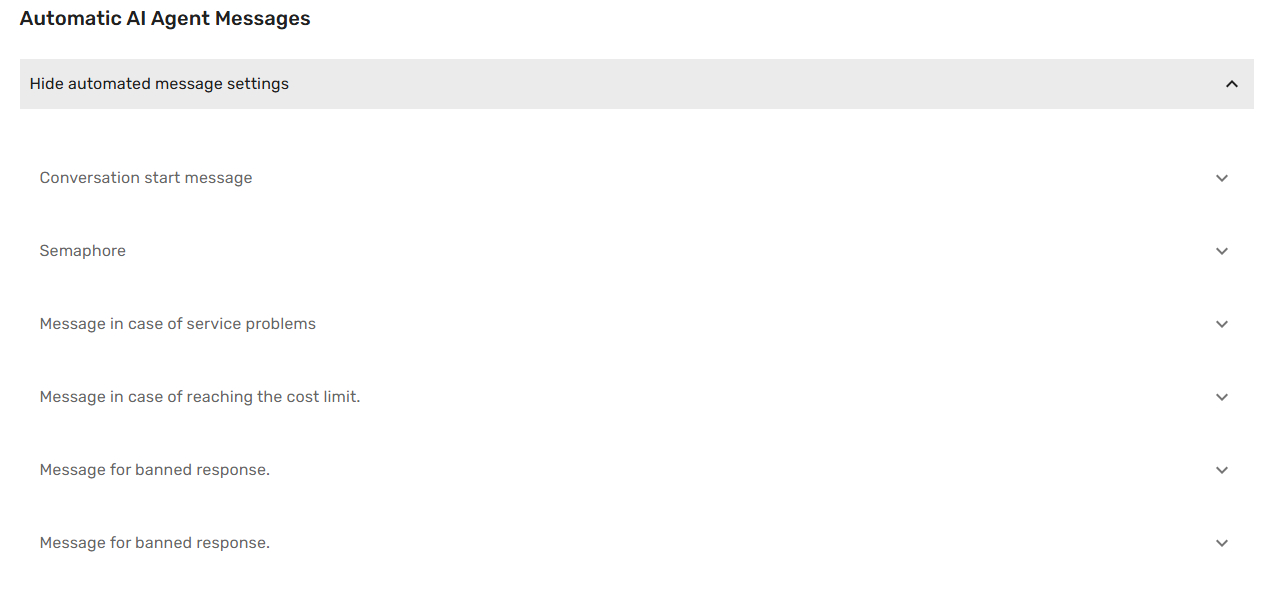
Response Categories
You can expand the settings to customize the following automated triggers:
- Conversation start message: The initial greeting sent when a user first interacts with the AI agent.
- Semaphore: Technical response settings used to manage flow control during high-traffic or processing intervals.
- Message in case of service problems: A fallback message delivered if the AI service encounters a technical error or downtime.
- Message in case of reaching the cost limit: An automated notification sent if the project’s predefined API expenditure threshold is met.
- Message for banned response: The specific reply given when a user’s query triggers the Input Blacklist or if the bot is prevented from using terms in the Output Blacklist.
Multi-Media Content Options
For each of these categories, you are not limited to plain text. You can select the specific type of content that best fits your communication strategy:
- Available Formats: None (no message), Text, Document, Image, Audio, or Video.
3. Customer Service Hours
The Customer Service Hours section allows you to define exactly when your contact center is operational. Setting these hours ensures that automated out-of-office messages are triggered correctly when users reach out to your business during non-working times.
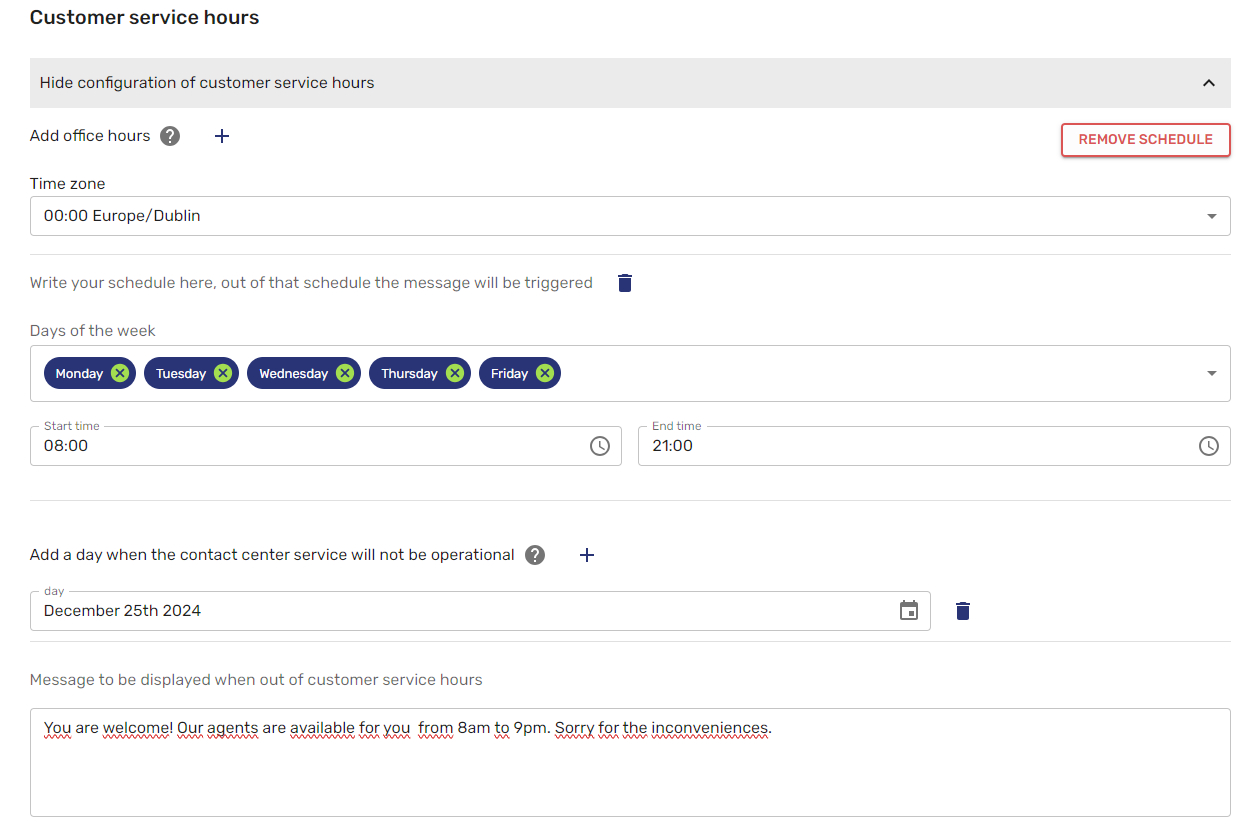
Configuring Your Schedule
You can create a highly customized availability plan using the following tools:
- Time Zone: Select your local time zone (e.g., +00:00 Europe/Dublin) from the dropdown menu to ensure the schedules align with your team's actual location.
- Office Hours Blocks: You can add multiple schedule blocks to cover different shifts or split days. For each block, you can select:
- Days of the week: Choose specific days (e.g., Monday through Friday).
- Time Range: Set the start and end times for those specific days (e.g., 08:00 to 21:00).
- Weekend/Special Shifts: You can add a separate block for days with reduced hours, such as Saturdays (e.g., 09:00 to 14:00).
Non-Operational Days (Holidays)
To account for specific dates when the service will be closed regardless of the weekly schedule:
- Add a Day: Use this feature to select specific calendar dates (e.g., January 1st, 2027) when the contact center service will not be operational.
Facebook ID
It is possible to use the Facebook ID of the user to identify the conversation as a conversation ID.

Reports
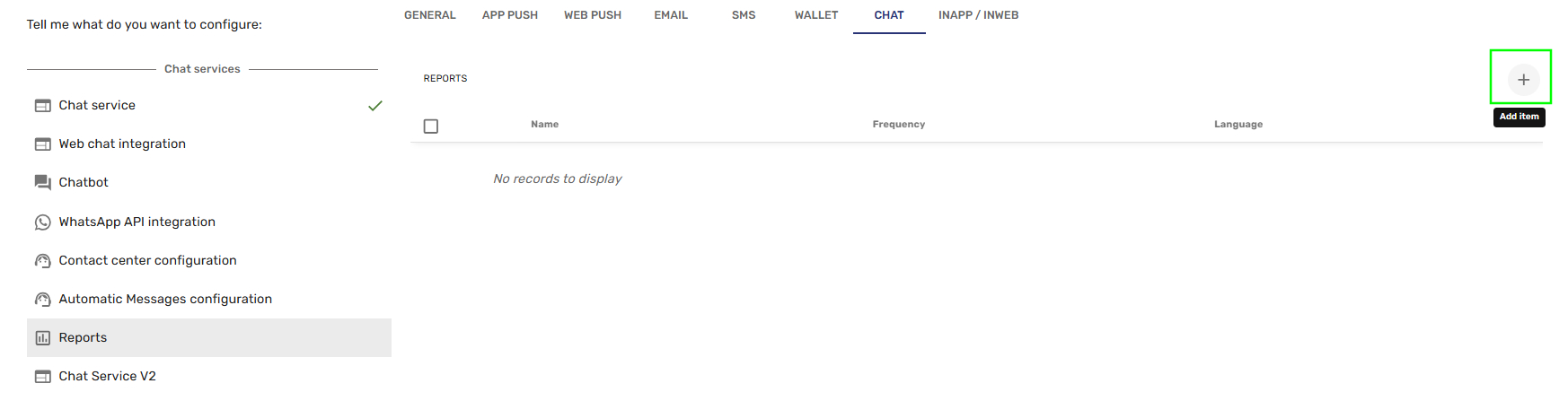
The Reports section provides a comprehensive overview of your communication performance, allowing you to monitor and analyze activity across your chat channels. This module enables you to automate the delivery of key metrics directly to your team's inbox.
Managing Your Reports
The main dashboard displays all currently active reports:
- Report List: View the name, delivery frequency, and language for each scheduled report.
- Add New Report: To set up a new automated data export, click the "+" (Add item) button located in the top right corner of the interface.
Creating a Custom Report
When you choose to create a new report, a configuration window will appear with the following options:
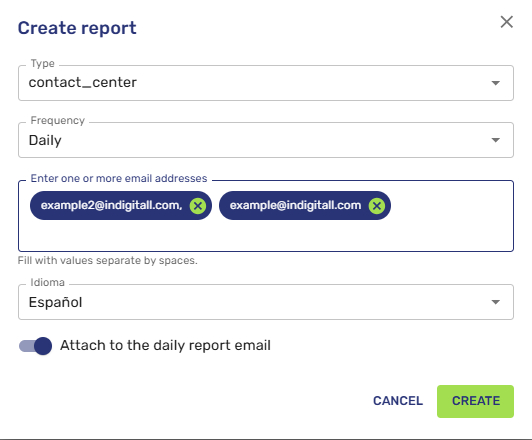
- Type: This field automatically displays the name of your specific Contact Center to identify the data set you will analyze.
- Frequency: Currently, reports are generated on a Daily basis to ensure you have the most up-to-date metrics.
- Email Destinations: Enter one or more email addresses to receive the reports. The interface allows you to add multiple recipients by separating addresses with spaces.
- Language: Choose the preferred language for the report content. The available options are Spanish, English, and Portuguese.
- Email Attachment: Use the toggle to confirm if you want the data file to be attached directly to the delivery email.
Click the green "CREATE" button at the bottom right of the configuration window to save your settings.
Chat Service V2 Integration
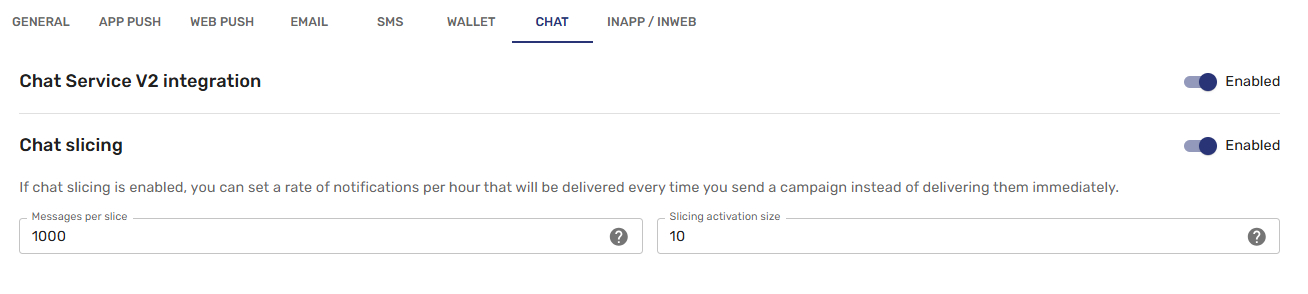
The Chat Service V2 Integration section provides updated infrastructure for managing high-volume messaging campaigns. This version includes enhanced delivery controls to optimize how your system handles large-scale notifications.
To activate this updated service, you must manage the primary integration toggle:
- Chat Service V2 integration: Use the main switch to set the service to Enabled. This activates the V2 framework for your project.
Chat Slicing
The V2 integration features a specialized Chat slicing mechanism. When enabled, this tool allows you to stagger the delivery of your notifications rather than sending the entire campaign at once. This is highly recommended for managing server load and inbound traffic to your support team.
You can customize the slicing behavior through the following fields:
- Messages per slice: Define the specific number of notifications that will be delivered in each hourly interval (e.g., 1000).
- Slicing activation size: Set the minimum campaign volume required to trigger the slicing process (e.g., 10). Campaigns smaller than this number will be sent immediately.
Meta Service API Integration
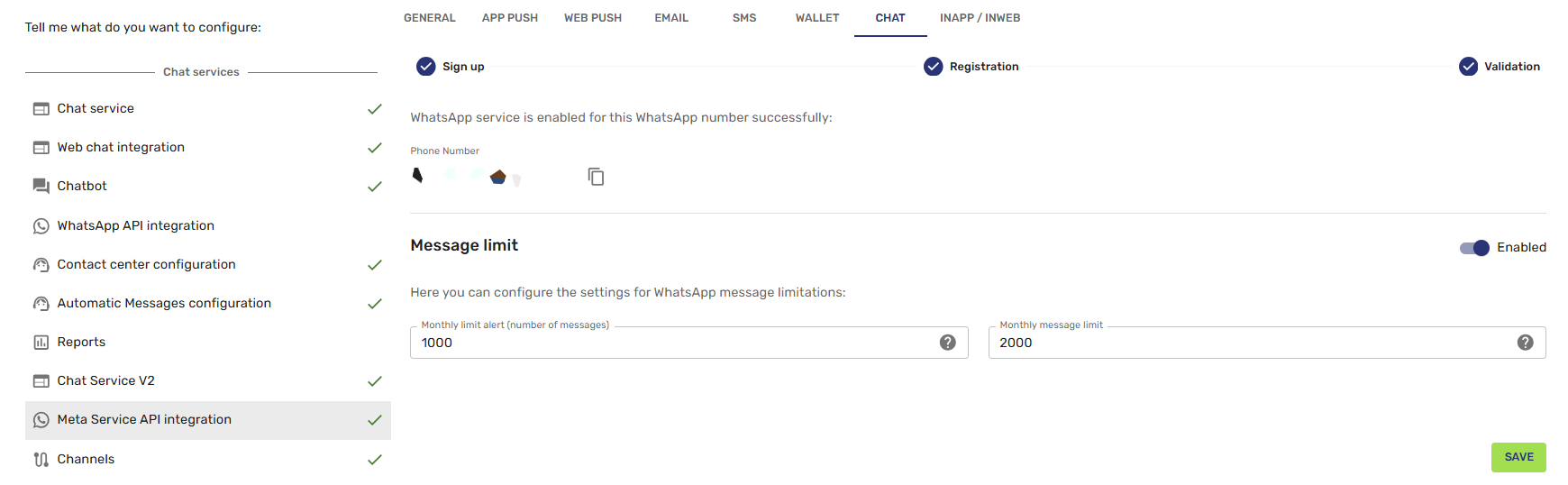
The Meta Service API Integration section allows you to manage the official connection for Meta-owned messaging platforms, such as WhatsApp. This module is designed to help you monitor usage limits and ensure your integration remains active and validated.
Integration Status
At the top of the section, you can track the real-time status of your official Meta connection:
- Validation Milestones: The interface displays the current status of the Sign up, Registration, and Validation phases. A blue checkmark indicates that the step has been successfully completed.
- Service Confirmation: A confirmation message will appear once the service is successfully enabled for your specific phone number.
- Phone Number: The registered number associated with this Meta integration is displayed here for easy reference.
Message Limit Configuration
To help you manage costs and messaging volume, you can configure specific thresholds:
- Message Limit Toggle: Use this switch to Enable or disable global limitations on your messaging campaigns.
- Monthly Limit Alert (number of messages): Define the threshold at which the system should send a notification alert (e.g., 1000 messages).
- Monthly Message Limit: Set the absolute maximum number of messages that can be sent through this integration per month (e.g., 2000 messages).
Channels
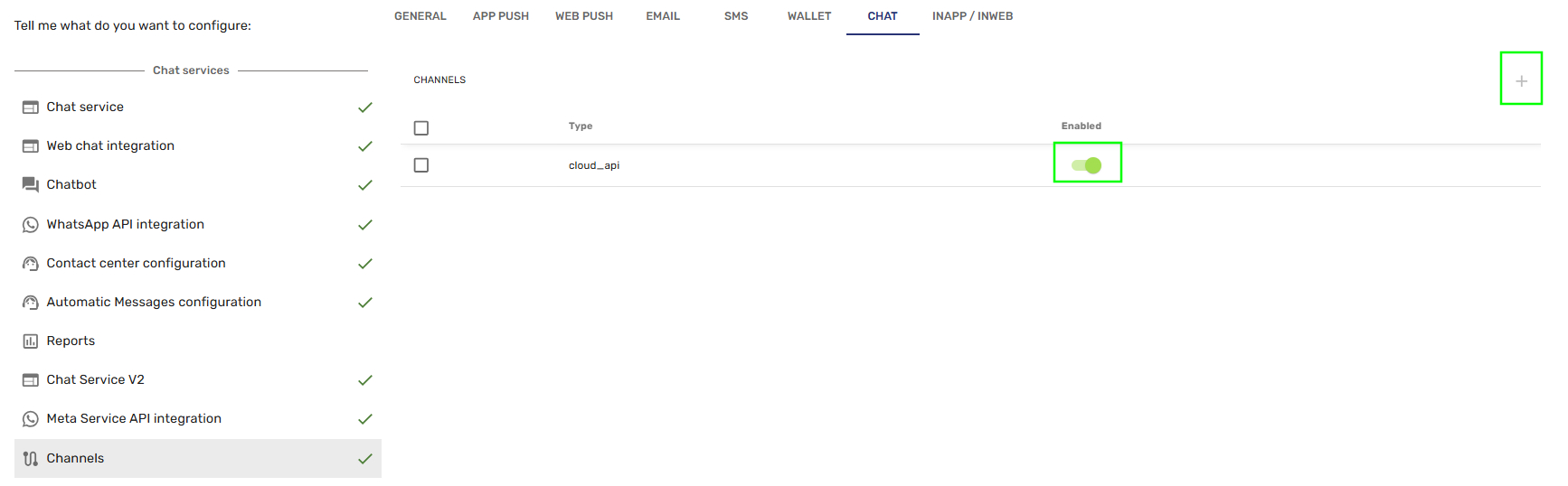
The Channels section serves as your overview and management center for all active communication methods within your project. This module allows you to quickly verify which specific APIs or services are operational and gives you the flexibility to expand your connectivity.
Managing Your Active Channels
The dashboard provides a clear list of your current integrations:
- Channel List: Displays the Type of each service currently configured (e.g., cloud_api).
- Status Toggle: Use the green Enabled switch to instantly activate or deactivate a specific channel.
- Add Channel: Click the "+" (Add item) button located at the top right of the channel list to initiate the setup for a new communication type.
New Chat
All Chat channel settings live under Configure > Chat V2 inside a project. Open your project, go to the top row of channel tabs (General, App Push, Web Push, Email, SMS, Wallet, Chat V2, InApp/InWeb) and select Chat V2.
Inside Chat V2, a second navigation column titled Chat services lists eight sections. A green checkmark next to a section means it already has a valid, saved configuration:
| Section | What it controls |
|---|---|
| Chat service | Master switch for the channel, message throttling (chat slicing), and the AI/automation disclaimer shown to contacts |
| Auto-reply integration | A generic automatic reply sent to incoming messages |
| Contact Center Integration | Human-agent routing: concurrency limits, assignment timeouts, transfer and inactivity messages |
| Customer service schedule | Weekly working hours and holiday calendar used by the out-of-hours logic |
| Pathbot integration | Connection to indigitall's Pathbot conversational flows |
| Pathbot integration | Connection to a Typebot conversational flow |
| Typebot integration | WhatsApp Business number registration and monthly message limits |
| Meta Service API integration | Which underlying chat channel types (WhatsApp Cloud API, web chat) are active |
Each of these sections has its own Save button at the bottom of the form; saving one section does not save the others, so changes in different sections must be saved separately.
Chat service
This is the master section for the channel. It has to be enabled before any of the other Chat V2 sections can send or receive messages.
| Setting | Type | What it does |
|---|---|---|
| Chat service integration | Toggle | Turns the entire Chat channel on or off for this project. When off, none of the sections below are active, regardless of their own settings. |
| Chat slicing | Toggle | Instead of delivering every campaign message the moment it is sent, spreads ("slices") delivery over time at a controlled rate. Useful for large sends where sending everything instantly could overload agents, bots, or the underlying messaging provider. |
| Messages per slice | Number | Only shown when Chat slicing is enabled. The number of messages delivered in each slice (batch) — for example, 500. |
| Slicing activation size | Number | Only shown when Chat slicing is enabled. The minimum campaign size (number of recipients) at which slicing kicks in — for example, 10. Campaigns smaller than this are sent immediately without slicing. |
| Disclaimer message | Toggle | When enabled, sends a fixed disclaimer message to the contact before the very first automated (bot/integration) response they receive, so the person knows they are talking to an AI-assisted or automated system. |
| Message text | Text area | Only shown when the disclaimer is enabled. The disclaimer wording itself — for example, a note that a virtual assistant using AI is answering and that the contact should verify important information through other official channels. |
| Message language | Dropdown | The language the disclaimer text above is written in (for example, Spanish). This tells the platform which language to treat the message as for translation purposes. |
| Translate the message | Toggle | When enabled, the disclaimer is automatically translated into the contact's own language instead of always being sent in the language selected above. |
Click SAVE CONFIGURATION at the bottom of this section to apply changes.
Auto-reply integration
A lightweight integration that sends a single, fixed automatic reply to incoming chat messages, without any bot logic or agent involvement.
| Setting | Type | What it does |
|---|---|---|
| Enabled | Toggle | Turns this integration on or off. |
| Priority | Number | Determines which integration answers an incoming message when more than one integration (auto-reply, Contact Center, Pathbot, Typebot) is active at the same time. A higher number means higher priority; the integration with the highest priority handles the message. Use a whole number of zero or greater, and avoid giving two integrations the same priority. |
| Default reply content — content type | Dropdown | The kind of content the auto-reply sends: None, Text, Document, Image, Audio, or Video. This same dropdown appears on every automated-message field throughout Chat V2. |
| Default reply content — Text | Text area | Shown when the content type is set to Text. The actual reply message sent to the contact. |
Click SAVE CONFIGURATION to apply changes.
Contact Center Integration
This is the largest section: it connects the chat channel to indigitall's Contact Center, where human agents handle conversations. It covers agent capacity, routing, and every automated message the system sends around an agent-handled conversation.
| Setting | Type | What it does |
|---|---|---|
| Enabled | Toggle | Turns the Contact Center integration on or off. |
| Priority | Number | Same concept as in Auto-reply integration: when several integrations are active, the one with the highest priority number handles incoming messages. Avoid duplicate priorities across integrations. |
| Maximum concurrent chats per agent | Number | The maximum number of conversations that can be assigned to one agent at the same time — for example, 2. Protects agents from being overloaded with simultaneous chats. |
| Contact center time zone | Dropdown | The time zone used for every time-based rule in this integration (schedules, timeouts), for example UTC+1 Europe/London. |
| Show contact code | Toggle | Displays, alongside each conversation, an identifier for the contact: the number Meta assigns for WhatsApp (similar to a phone number), or the contact's own identifier on other channels. |
Controls how a conversation is handed to an agent, and what automated messages are sent around that handoff.
| Setting | Type | What it does |
|---|---|---|
| Timeout (minutes) | Number | The maximum time, in minutes, a contact will wait for an agent to be assigned before the "failed to assign" message (below) is triggered — for example, 5. |
| Show/Hide automated message settings | Expand link | Reveals or hides the three message blocks below; it does not change any values by itself. |
| Message after agent assignment | Content type + text | Sent to the contact once an agent has been assigned to the conversation. Uses the standard content-type dropdown (None/Text/Document/Image/Audio/Video). |
| Message after closed by agent | Content type + text | Sent to the contact when an agent manually closes the conversation. |
| Message after failing to assign to any agent | Content type + text | Sent to the contact if no agent could be assigned within the assignment timeout above. |
| Setting | Type | What it does |
|---|---|---|
| Message after transfer to another agent | Content type + text | Sent to the contact when their conversation is handed from one agent to a different one. |
These settings define what happens when a contact writes outside the hours defined in the Customer service schedule section (covered later in this guide).
| Setting | Type | What it does |
|---|---|---|
| Unattended contacts list | Dropdown | A contact list that every user who writes outside the configured service hours is automatically added to, so those contacts can be followed up on later (for example, with a campaign). |
| Empty contact list after sending | Toggle | When enabled, the unattended contacts list above is cleared out automatically once a message or campaign has been sent to it. |
| Message when outside customer service hours | Content type + text | Sent automatically to a contact who writes outside the configured service hours. |
Controls how the system handles a conversation that has gone quiet.
| Setting | Type | What it does |
|---|---|---|
| Enabled | Toggle | Turns on automatic closing of inactive conversations. |
| Timeout (minutes) | Number | How long a conversation can sit with no new messages before it is automatically closed — for example, 30 minutes. |
| Inactivity reference mode | Dropdown | Which side's messages count as "activity" and reset the inactivity timer: Both (a message from either the agent or the contact keeps the chat open), Agent (only the agent's replies keep it open), or Contact (only a message from the customer keeps it open). |
| Message after automatic close by inactivity | Content type + text | Sent to the contact when the conversation is closed automatically for inactivity. |
All of these settings are saved together with the rest of Contact Center Integration using the SAVE CONFIGURATION button.
Customer service schedule
This section defines exactly when human customer service is considered "in hours." Outside these windows, the "Message when outside customer service hours" (Contact Center Integration) is sent instead of routing to an agent.
A table with columns Group, Days, and Hours. Each row is one time block, for example a group covering Monday–Friday from 07:15 to 23:00, and a separate group covering Sunday from 09:00 to 12:00. An expand/collapse control at the top of the table shows or hides all rows at once, and rows can be selected with their checkboxes for bulk deletion.
Clicking the pencil icon on a row opens the Edit week days dialog:
| Field | Type | What it does |
|---|---|---|
| Day chips (e.g. Monday, Tuesday...) | Multi-select chips | The days this group of hours applies to. Days can be added or removed individually. |
| From / To | Time pickers | The start and end time of a service window on the selected days. |
| + Add another time slot | Link | Adds a second (or further) time window to the same group of days — useful for a split schedule such as morning and afternoon shifts. |
| + Add days group | Button | Creates an additional group of days with its own independent hours, alongside the current one. |
| Save schedule | Button | Saves the changes made in this dialog. |
A separate table with columns Date, Recurrence, and Schedule, listing exceptions to the weekly schedule above — for example, a fixed holiday every year, or a specific one-off date with its own reduced hours. New entries are added with the + Add item button; existing ones are edited via the pencil icon, which opens the Edit holiday dialog:
| Field | Type | What it does |
|---|---|---|
| Recurring date (disabled every year) | Toggle | When enabled, this date is treated as recurring on the same day/month every year (for example, a fixed public holiday) rather than a single specific year. |
| Day / Month | Number + dropdown | The calendar date of the holiday. |
| + Add time range | Link | Adds a service-hours window for that date. Leaving no time range at all means the business is fully closed that day. |
| Save | Button | Saves the holiday entry; disabled until the entry is valid. |
After editing either table, click SAVE CONFIGURATION to persist the schedule.
Bot integrations
Connects the chat channel to an indigitall Pathbot conversational flow.
| Setting | Type | What it does |
|---|---|---|
| Enable Pathbot integration | Toggle | Turns the Pathbot connection on or off. |
| Priority | Number | Same priority logic as the other integrations: the highest number among active integrations handles the incoming message. |
| Forward button clicks | Toggle | When enabled, clicks on interactive buttons inside the bot flow are forwarded to Pathbot as events, rather than only being handled inside the chat UI. |
| Input blacklist | Tag list | Words that, if the contact writes them, are blocked from being sent to the bot. Enter values separated by spaces. |
| Output blacklist | Tag list | Words that are blocked from what the bot is allowed to say back to the contact. Enter values separated by spaces. |
| Alert emails | Tag list | Email addresses that receive automatic alerts about the cost of running this integration. |
Updated 6 days ago