
Campaigns and Customer Journey
A campaign and a customer journey differ in who decides the next step. A campaign sends a planned message to a defined audience: you choose the audience, the content, the channel and the send time before the send.
A customer journey decides what happens next for each person while the journey runs. A user can enter because of an event, a date, a profile condition or a segment, and the journey can then branch on that user's behaviour: an open, a click, a reply, a purchase, or no response at all.
- Use a campaign for a planned send with a fixed objective and audience.
- Use a customer journey when the next action depends on a signal that may differ from one person to the next.
| USE A CAMPAIGN WHEN | USE A CUSTOMER JOURNEY WHEN |
|---|---|
| The audience and the objective are defined before the send. | Users enter because of an event, a date, a profile condition or a segment. |
| The message and the send plan are prepared in advance. | The next step depends on what each user does, or does not do. |
| The send is a planned busines saction, such as a launch, a sale or a notice. | The journey branches on signals such as opens, clicks, replies, purchases or no response. |
| You need to report on one planned send. | You need to coordinate several steps, or re-evaluate the user as the journey progresses. |
Campaigns
The Campaigns menu gives you an intuitive interface to launch and manage communications across all available channels, both outbound and inbound. Each channel has its own tab: Push app/web, Email, Chat (including WhatsApp), SMS/RCS, and In app/web. Every tab lists your campaigns with their creation date, campaign type, sending type, and state. You can search, filter by category, and create a new campaign right from the same view. Built-in Artificial Intelligence optimizes delivery on every channel to automatically get you better engagement results.
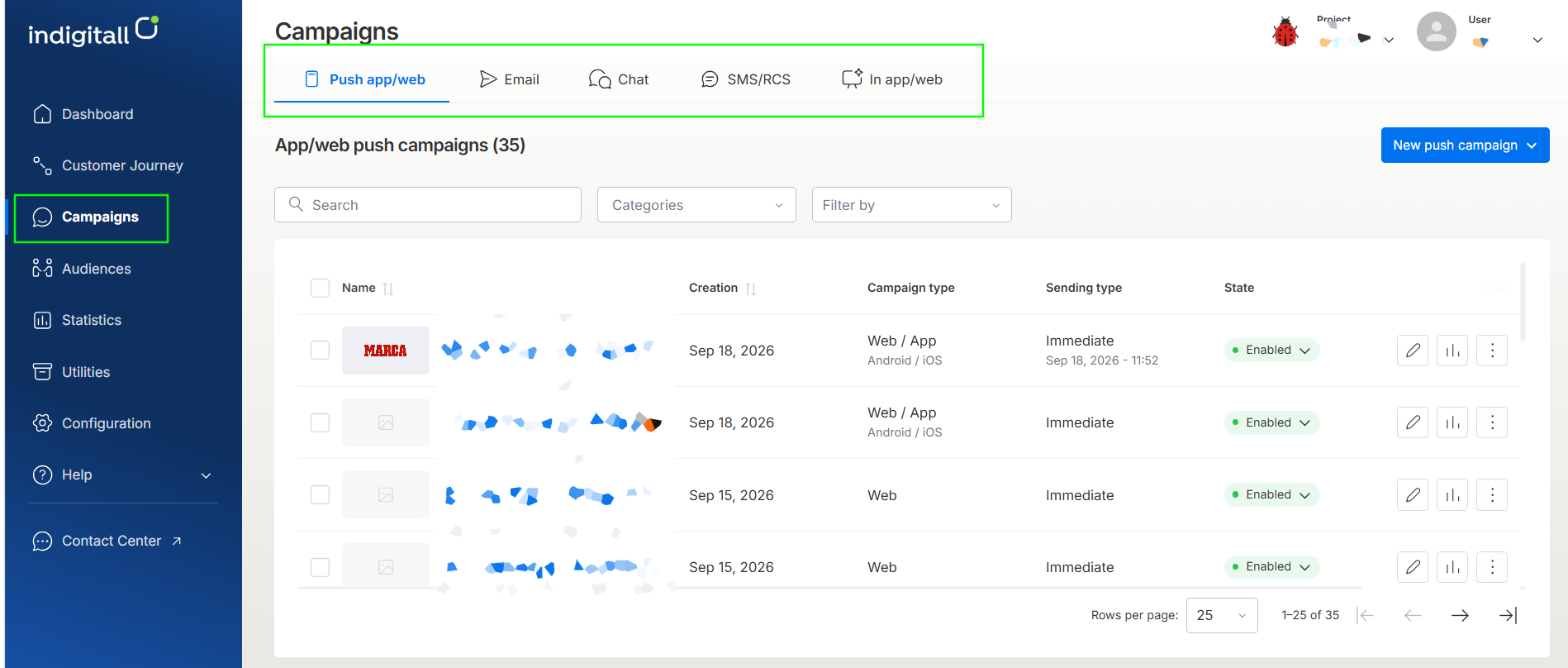

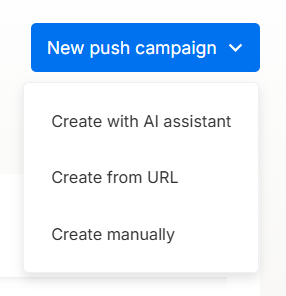
Create Push, Email, and SMS campaigns manually or use Generative AI to draft content automatically. You can also instantly convert a URL into a Push notification and access professional Email templates to simplify your design process.
Reach your audience instantly on their mobile devices or desktop browsers with high-impact push notifications >> https://documentation.indigitall.com/docs/about-push
Engage active users with personalized messages and banners triggered directly within your app or website. >> https://documentation.indigitall.com/docs/about-inappinweb
Build lasting relationships through professionally designed, automated email campaigns and newsletters. >> https://documentation.indigitall.com/docs/about-email
Ensure immediate visibility with time-sensitive alerts and promotions delivered straight to your customers' phones. >> https://documentation.indigitall.com/docs/about-sms
Power real-time, two-way conversations and customer support across your favorite messaging platforms. >> https://documentation.indigitall.com/docs/configuration
Deliver digital coupons, loyalty cards, and event tickets directly into your users' Apple or Google Wallet. >> https://documentation.indigitall.com/docs/about-mobile-wallet
Manage and deploy official WhatsApp message templates to initiate secure, verified business conversations. >> https://documentation.indigitall.com/docs/whatsapp-templates
How can I find the Campaign ID?
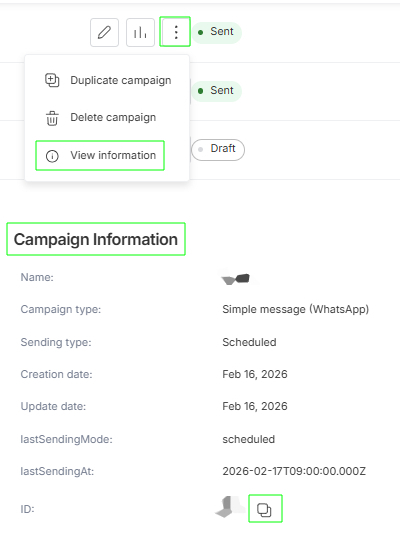
If you need to retrieve a specific Campaign ID or Journey ID for your records or API integrations, locate the campaign you are interested in within your dashboard. On the right-hand side of the campaign row, click the three vertical dots (icon) to open the action menu.
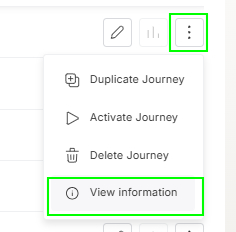
From the dropdown menu, select the View information option. A details panel will appear, displaying comprehensive data about your campaign or customer journey, including the name, type, and creation date. You will find the ID at the very bottom of this list. You can easily copy it by clicking the "copy" icon next to the ID string.
Alternatively, you can locate the ID by simply clicking on the campaign to open it. Look at your browser's address bar; the number appearing at the end of the URL is the Campaign ID or Journey ID.

New campaign URL structure
Starting October 14, campaign links in the console use a new, more focused structure. Each URL now shows which project, section, and channel a campaign belongs to:
console.indigitall.com/{ApplicationID}/{section}/{channel}/{ID}

Customer Journeys
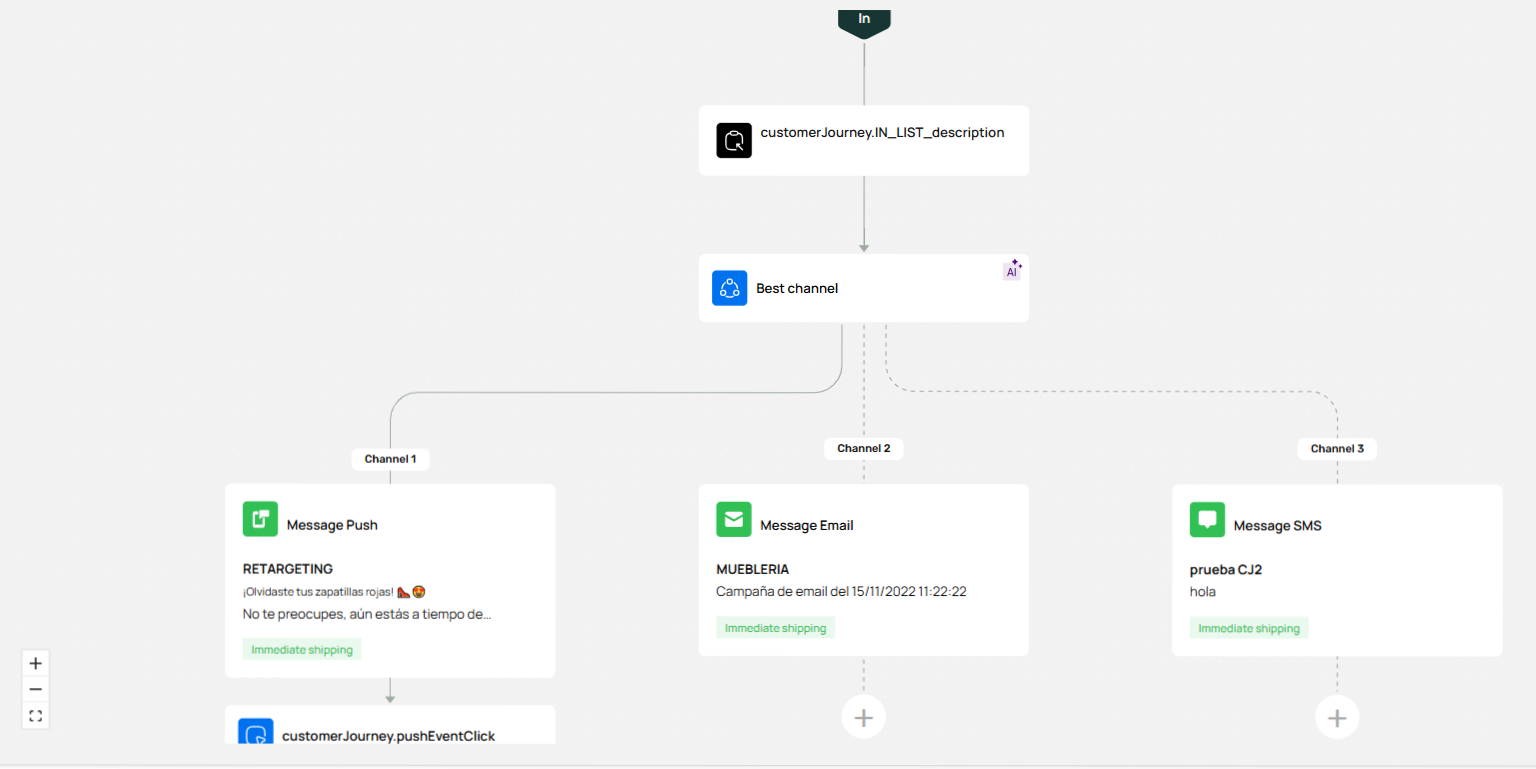
Instead of delivering disconnected messages across various campaigns, Customer Journey facilitates a continuous and seamless dialogue with users. They achieve this by adapting a user’s journey dynamically, branching into different paths based on their interactions—or lack thereof—with your brand. This enables real-time progression through personalized flows tailored to each user’s behavior.
Customer Journeys are effective for re-engaging users who veer off the path to conversion by placing them into the most effective outreach strategies. Creating a Customer Journey is similar to setting up a campaign—you define the target audience, entry criteria selecting where the customers starting the Journey though all database, client list (CSV format), filters or events, and delivery settings. The Customer Journey begins when someone meets the trigger condition and progresses through the defined path until they satisfy the exit conditions.
FAQ
When should I use a campaign and when should I use a customer journey?
Use a campaign when the audience and the content are decided before the send: everyone receives the same message at the same time. Use a customer journey when the next step depends on each person's behaviour (an event, a reply, a purchase, or the absence of one) and has to be resolved individually as it happens.
What can start a customer journey?
A journey can be started by an event, a date, or a profile trait. The audience can also enter from a contact list, a CSV file, a filter, or an event-based segment.
Does a journey react to what the user does, or only to what I schedule?
It reacts. A path can branch on a push event, an email open, an email click or an SMS event, on a filter over a customer field, or on an AI decision that selects the best path or the best channel for that user. You can add a branching point at any step of the journey, as many times as you need.
Can I edit a journey that is already live?
Yes, with a limit: you can update existing text, values and parameters. Do not introduce new variables or data tags that were not part of the original setup, because the live journey engine will not recognise them.
What happens to a user who is already inside a journey when I edit it?
Active users continue from their current step and immediately adopt the updated flow for all subsequent actions. For example, if a pending step is changed from SMS to WhatsApp, users who haven't received the message yet will get the new WhatsApp version.
Can a customer journey run on a single channel?
Yes. Journeys fully support single-channel flows (e.g., automated follow-up emails based on user interactions). While the platform's main strength is combining multiple channels, such as switching to WhatsApp if an email remains unopened, single-channel journeys are completely supported.
Updated 1 day ago